Why Does My Husband Ignore Me? Islamic and Psychological Reasons
By Team Khidma · Reviewed by Zulekha Shakoor Rajani
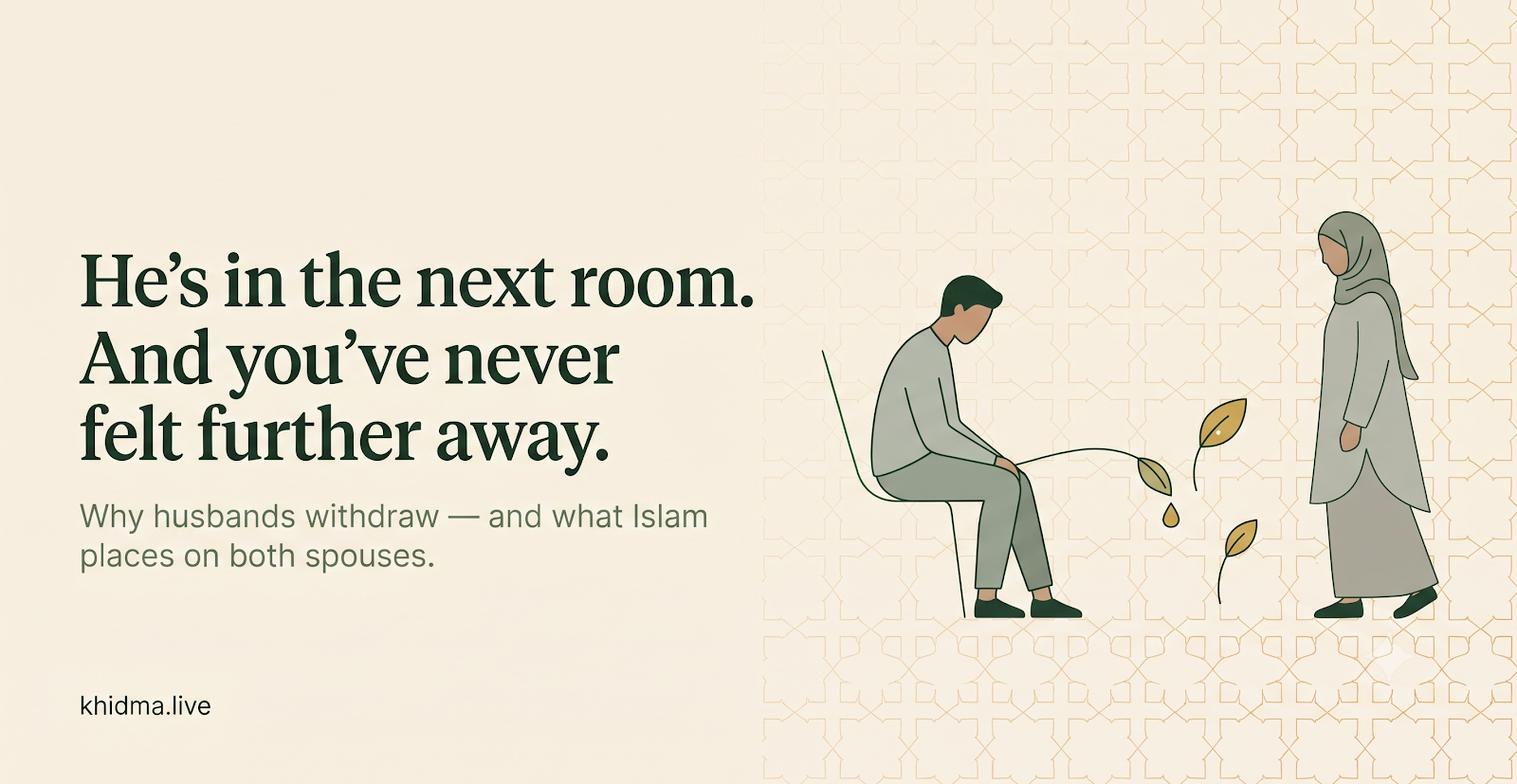
You've asked him what's wrong. He said "nothing."
You've tried again, gently. Then not so gently. You've cried and been met with a wall. You've cooked, cleaned, dressed up, stayed quiet, made dua — and he still looks past you like you're furniture in a room he's stopped noticing.
And the question that has started following you around the house: why does my husband ignore me?
Before anything else, one thing needs saying. Wanting your husband to see you is not neediness, weakness, or a failure of sabr. The Quran describes marriage as a place of tranquility, affection, and mercy (Surah Ar-Rum, 30:21). What you are missing is not a luxury you should be embarrassed to want. It is part of what your marriage was meant to contain.
This article covers the real reasons husbands withdraw — psychological and situational — how to tell ordinary withdrawal from something more serious, and what Islam actually places on both spouses.
First: There Is More Than One Reason a Husband Withdraws
The instinct, when someone shuts you out, is to assume you caused it. Most women in this situation have already run through every conversation of the last six months looking for the moment they broke something.
Usually that search comes up empty, because withdrawal rarely has a single clean cause. Here are the ones counsellors see most often.
He Never Learned How to Handle Difficult Emotions
Many men were raised in households where emotional expression wasn't modelled and wasn't safe. Sadness, fear, and overwhelm were things you swallowed. Nobody sat them down and taught them what to do with a feeling too big to name.
So when something becomes difficult — at work, in the marriage, inside himself — the only tool he has is retreat. He isn't choosing silence over talking to you. Silence is the only thing he knows how to do.
This is one of the most common reasons behind emotional withdrawal, and it is also one of the most treatable. It responds well to structured help, precisely because the problem is a missing skill rather than a missing feeling.
He Is Overwhelmed by Something Outside the Marriage
Financial pressure. Job insecurity. His own parents. A health worry he hasn't told you about. Many men interpret sharing these as failing at their responsibility to protect their family from stress — so they carry it silently and go quiet in the process.
From the inside, his withdrawal looks like rejection of you. From his side, it can be a badly executed attempt to shield you.
This does not make it acceptable. But it changes what will fix it.
The Withdrawal Is Deliberate
Sometimes silence is not a coping mechanism. It is a strategy.
When silence is used to punish, to force compliance, or to make you anxious enough to stop raising an issue, it has stopped being withdrawal and become something else. The distinguishing signs are consistency and control: it appears whenever you assert something, it lifts the moment you concede, and he can switch it off instantly for guests or family.
That pattern has both a psychological name and an Islamic weight to it. We've covered it in detail: when silence becomes toxic — the psychological and spiritual toll of the silent treatment.
Resentment Has Built Up Unspoken
Sometimes a husband withdraws because he is carrying grievances he has never voiced — often ones he doesn't feel entitled to voice, or doesn't have the language for. Resentment that never gets said out loud doesn't dissolve. It calcifies into distance.
You may genuinely have no idea what any of it is, because he has never told you.
The Connection Quietly Eroded
The least dramatic reason, and among the most common. No event. No fight. Just years of logistics replacing conversation — bills, children, schedules — until neither of you can remember the last real exchange you had.
This is emotional neglect, and it's rarely anyone's deliberate choice. It's what happens when a marriage runs on autopilot long enough.
What Islam Places on Him — and on You
Here is where cultural expectation and Islamic teaching often diverge sharply, and it's worth being precise.
In many Muslim households, the emotional temperature of a marriage is treated as the wife's responsibility. If he's distant, she should be more patient. More accommodating. Ask for less. If the marriage is cold, somehow it reflects on her.
That framing does not come from Islam.
The Quran establishes that spouses hold rights over one another, both ways: "And they (women) have rights similar to those (of men) over them in kindness." (Surah Al-Baqarah, 2:228). Similar rights. Mutual obligation. Not one spouse serving and the other receiving.
And the Prophet ﷺ set a standard of conduct in his own marriages that no cultural norm of his time required of him. He was affectionate, present, and attentive with his wives. He described the best of men as those best to their families. Emotional presence in a marriage is not beneath a husband's dignity in Islam — it's the standard.
So the honest question is not what more can I do to earn his attention. It's why has a mutual obligation collapsed on one side, and what will it take to restore it.
That distinction matters practically, not just theologically. Women who understand it stop trying to fix a two-person problem alone — which is the single most exhausting and least effective thing you can do. For more on where the boundaries of marital authority actually sit, see the limits of a wife's obedience in Islam.
What Actually Helps — and What Makes It Worse
What tends to make it worse:
- Pursuing harder. The more you chase, the further many withdrawn men retreat — it's a well-documented cycle where each person's response fuels the other's.
- Matching his silence. Understandable, but it typically deepens the freeze rather than getting his attention.
- Involving family early. It raises the stakes, invites judgment, and usually makes him defensive rather than open.
- Waiting it out indefinitely. Sabr is genuinely called for in marriage — but sabr as active perseverance, not sabr as indefinite endurance of a slow disappearance.
What tends to help:
- Raise it outside the moment. A calm conversation on a neutral afternoon lands differently than one at the peak of the silence.
- Describe the effect, not the accusation. "I've been feeling alone in this house" opens a door that "you always ignore me" closes.
- Ask one direct question and let the silence sit. "Is there something you've been carrying that you haven't told me?" Then wait. Don't fill the gap.
- Bring in a qualified third party. This is the step most couples reach far too late.
When to Stop Trying to Solve It Alone
This is also the point where many people decide to simply endure it — often for the sake of the children. That decision deserves examining rather than defaulting into: what Islam actually says about staying in a loveless marriage.
If you've been reading this looking for the technique that finally reaches him, here is the most useful thing in the article:
Withdrawal patterns are extremely difficult to break from inside the marriage. Not because you aren't trying hard enough — because both people are inside the loop, and neither can see it clearly enough to interrupt it. That's the nature of the pattern, not a reflection of your effort.
This is precisely the situation the Quran addresses by prescribing outside arbitration when a marriage falls into discord (Surah An-Nisa, 4:35). Bringing in someone qualified isn't an escalation or an admission of failure. It's the mechanism.
On Khidma.live, that takes two forms. A verified Islamic scholar can clarify what each of you owes the other — which matters enormously when a husband believes his obligations end at provision. And a certified Muslim psychologist can identify the withdrawal pattern and give you both practical tools to interrupt it.
You can start by yourself. Many women do — getting clarity on their own situation before deciding whether or how to involve their husband. Sessions are private, audio-only, and nobody in your life will know you reached out.
Frequently Asked Questions
1. Why does my husband ignore me?
Common reasons include not having learned how to handle difficult emotions, being overwhelmed by pressures outside the marriage, unspoken resentment, gradual erosion of connection, or — in some cases — deliberate use of silence to control or punish. Identifying which is happening determines what will actually help.
2. Is it normal for a husband to go quiet after an argument?
Brief withdrawal to cool down is common and human. What isn't healthy is silence extending for days or weeks, or being used as a tool to punish. The distinction lies in whether it's followed by genuine conversation.
3. What does Islam say about a husband ignoring his wife?
Islam establishes mutual rights between spouses "in kindness" (Al-Baqarah 2:228), and the Prophet ﷺ modelled affection and presence with his wives. Sustained emotional withdrawal is a failure to meet a mutual obligation, not an acceptable norm. For rulings on a specific situation, a qualified scholar should be consulted.
4. Is my husband ignoring me my fault?
Almost never in the way you fear. Withdrawal usually stems from the husband's own coping patterns, pressures, or unspoken resentments. A marriage takes two people, and so does repairing one — but the withdrawal itself is generally not something you caused.
5. Should I give him space or keep trying to talk?
Both extremes tend to backfire. Constant pursuit often drives further retreat; complete withdrawal on your side deepens the freeze. What usually works better is raising it calmly outside the heat of the moment, describing the effect on you rather than accusing, and then allowing space for a real answer.
6. How long is too long for a husband to ignore his wife?
If it extends beyond a few days, recurs regularly, or is used whenever you raise an issue, it has moved past cooling off. For the Islamic dimension of this specifically, see is the silent treatment haram in Islam.
7. Can a marriage recover from long-term emotional withdrawal?
Often, yes. Withdrawal is frequently a missing skill rather than absent feeling, and skills can be built. Recovery generally requires both spouses to engage and usually benefits significantly from qualified guidance, because the pattern is hard to break from inside.
8. Should I involve my family?
Usually not as a first step. Family involvement raises the stakes, introduces bias, and often makes a withdrawn husband more defensive. A neutral, qualified third party — which is what the Quran prescribes in An-Nisa 4:35 — tends to be far more effective and keeps your marriage private.
9. Can I get help without my husband's involvement?
Yes. Many women begin with individual sessions to understand their situation and their options before deciding whether to involve their husband. Sessions on Khidma.live are completely private.
10. How can Khidma.live help?
Khidma.live connects you privately with verified Islamic scholars and certified Muslim psychologists — the scholar to clarify what each spouse owes the other, the psychologist to identify and interrupt the withdrawal pattern. You can ask a free question first.
Being Seen Is Not Too Much to Ask
Living beside someone who has stopped noticing you is a specific and exhausting kind of loneliness — made worse by the sense that you shouldn't complain, because nothing dramatic is happening.
Something is happening. A marriage was meant to be a place of tranquility and mercy, and yours currently isn't. That is worth taking seriously, and worth getting real help for.
Khidma.live connects Muslims with verified Islamic scholars trained at Masjid al-Haram and Madinah University and certified Muslim psychologists — for private, confidential guidance across the United States, United Kingdom, and UAE.
Ask your first question for free →