Islamic Marriage Counseling Online: A Complete Guide for Muslim Couples
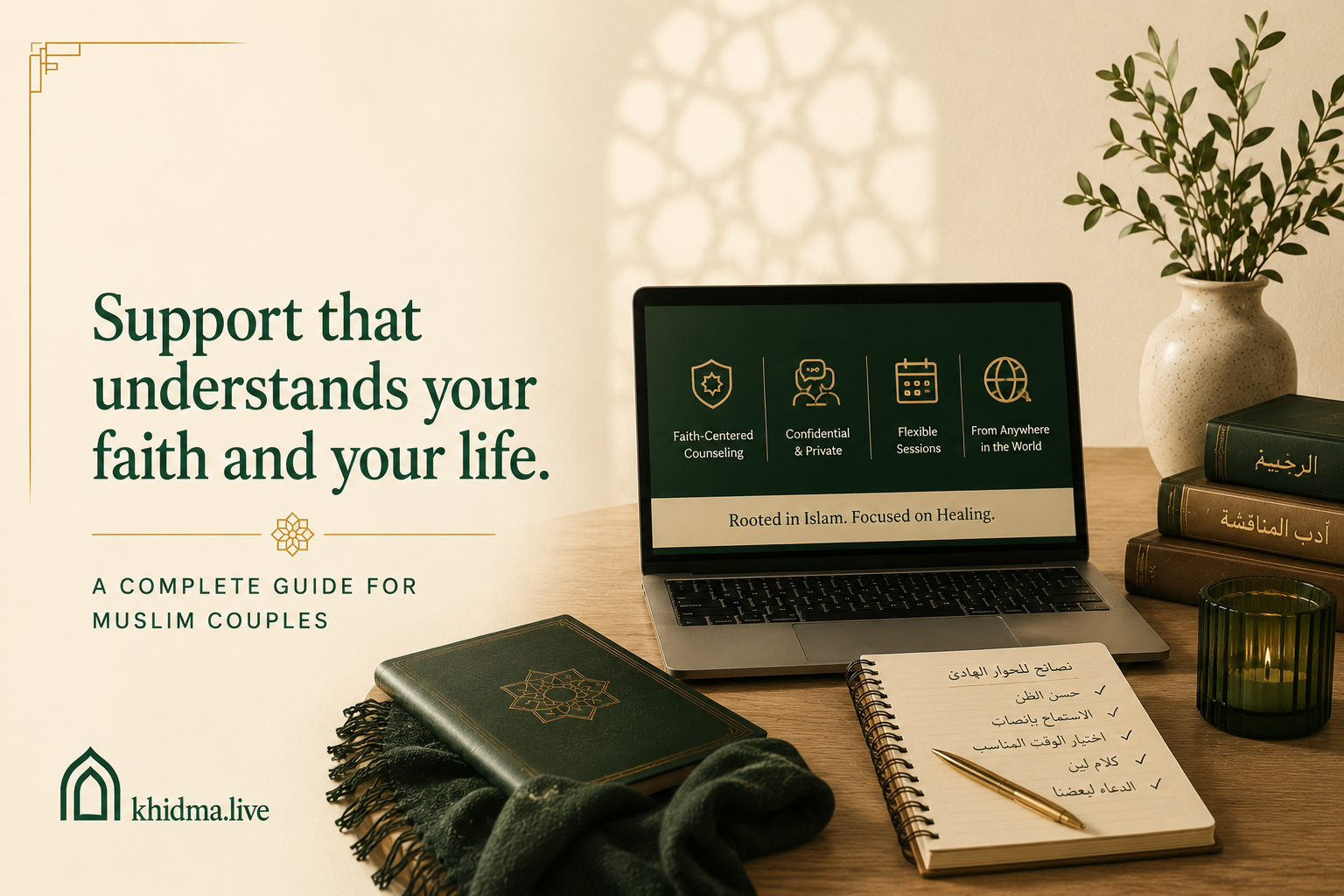
Marriage in the Quran is described as a source of Sakinah (tranquility), Mawaddah (love), and Rahmah (mercy). Yet for millions of Muslim couples today — particularly those living in the diaspora across the United States, United Kingdom, and UAE — that tranquility can feel distant, unreachable, or buried under years of unresolved conflict. The challenge has never been a lack of Islamic guidance. The challenge has been access to it. Finding a qualified Muslim marriage counselor who understands both the clinical dimensions of relationship breakdown and the specific Islamic context of your situation is genuinely difficult. Local imams are often inaccessible to women, embedded in community networks, or unequipped to handle complex psychological dynamics. Secular therapists offer clinical tools without Islamic grounding. Online fatwa forums deliver generic rulings that cannot account for the full picture of your life. This guide explains what Islamic marriage counseling online actually is, who it is for, what specific situations it addresses, and how to find the right expert — whether that is a verified Islamic scholar, a certified Muslim therapist, or both.
What Is Islamic Marriage Counseling?
Islamic marriage counseling is a structured guidance approach that integrates clinical psychology with Islamic jurisprudence and prophetic wisdom. Unlike conventional couples therapy — which operates from a purely individualistic, secular framework — Islamic marriage counseling operates within the spiritual architecture of the Nikah. This means the counselor or scholar understands that marriage is a sacred covenant, not simply a legal contract. It means the tools used in sessions — communication frameworks, emotional regulation techniques, boundary-setting — are anchored in Islamic values rather than applied without cultural or religious context. Core Islamic principles that shape faith-based marriage counseling include: Shura (Mutual Consultation): Shifting communication from reactive arguments to collaborative problem-solving, rooted in the Quranic command that spouses consult one another in their affairs. Ihsan (Excellence in Conduct): Encouraging both partners to treat one another with the highest standard of care — even during periods of intense conflict. Adl (Justice): Understanding the reciprocal rights and responsibilities that Islam assigns to each spouse — and addressing situations where those rights are not being upheld. For a deeper understanding of what Islam says about marriage itself, read The Reality of Marriage in Islam: Love, Unity, and Letting Go of Ego by Sheikh Noor ul Hasan Madani.
Why Muslim Couples Are Choosing Online Islamic Marriage Counseling
The shift toward online Islamic marriage counseling is not simply a post-pandemic convenience. It is a structural necessity for most Muslim couples in the diaspora. Research on Muslim divorce rates globally shows that less than 50% of mosque imams in Western countries hold any formal counseling qualification. The physical mosque — for all its importance — is a public, visible space where seeking help triggers community stigma, gossip, and fear of judgment. Many Muslim women cannot access local imams privately at all. Online Islamic marriage counseling solves this structurally: Complete Privacy: Sessions take place entirely online, from wherever you are. No community members. No shared waiting rooms. No running into familiar faces. What is shared in a session stays in the session. Access to Verified Experts: Online platforms connect you with qualified Muslim therapists and Islamic scholars regardless of your location. Whether you need a scholar trained at Masjid al-Haram in Makkah for an Islamic ruling, or a certified Muslim psychologist for emotional support, geography is no longer a barrier. Flexibility: Sessions fit around work schedules, family responsibilities, and time zones — without requiring both spouses to travel to the same physical location.
Common Situations That Bring Muslim Couples to Islamic Marriage Counseling
Talaq Said in Anger — What Happens Next? One of the most common and urgent situations that brings Muslim women to seek Islamic guidance online is uncertainty following talaq spoken during an argument. The question — "Is my marriage still valid?" — has a precise answer in Islamic jurisprudence that depends on the exact words used, the state of mind at the time, the madhab followed, and whether witnesses were present. This is not a question that can be safely answered by a forum post or a general fatwa website. A wrong ruling applied to the wrong situation carries serious Islamic consequences. It requires a private, one-on-one conversation with a verified Islamic scholar who has heard the full context. Sheikh Abdur Rehman Haran — who spent 7 years at the Fatwa Centre of Masjid al-Haram in Makkah — specializes in exactly these questions, available for private sessions through Khidma. Emotional Unavailability and the Silent Marriage Perhaps the most widespread and least discussed form of marital distress among Muslim couples is emotional unavailability — the experience of being physically present in a marriage while feeling completely invisible within it. She prays alongside her husband. They share a home, a table, a bed. But there is no real conversation. No emotional presence. No acknowledgment of her inner life. She has been told to make sabr. She has been told this is just what marriage is. She is not sure anymore. This is not a minor marital issue. Research on emotional neglect in Muslim marriages shows it is one of the leading causes of marital breakdown, khula petitions, and long-term psychological harm. It also has a specific Islamic dimension — a husband's emotional obligations to his wife are documented in the Sunnah, and a Muslim psychologist or scholar can address both what Islam says about those obligations and the clinical tools for rebuilding emotional connection. Read more: Is Emotional Neglect Grounds for Khula? An Islamic Perspective
In-Law Pressure and Boundary Conflicts
The tension between a husband's obligations to his parents and his primary responsibility to his wife is one of the most culturally loaded areas of Muslim marriages — particularly in South Asian diaspora communities in the US, UK, and UAE. She is expected to serve his family without complaint. Her boundaries are framed as disobedience. The husband, caught between two loyalties, defaults to silence. She is isolated within his family's home while the community praises him as a devoted son. Islamic jurisprudence is clear on the rights of a wife to her own household and to her husband's undivided emotional support. A session with a verified Islamic scholar can clarify exactly where Islamic obligation ends and cultural expectation begins — providing her with the clarity she needs to understand her rights, and him with the framework to fulfil both sets of responsibilities without conflict. Communication Breakdown and the Silent Treatment Prolonged silence used as punishment — stonewalling — is one of the most psychologically damaging patterns in any marriage. In a Muslim marriage, it carries an additional Islamic dimension: the prohibition on a Muslim abandoning their fellow Muslim for more than three days. When silence becomes a weapon rather than a pause, its impact extends far beyond the argument that triggered it. A Muslim therapist with clinical training can identify the communication patterns driving the breakdown and offer practical tools to interrupt them — within an Islamic framework that both spouses can commit to.
The Islamic Framework: Seeking Help Is Sunnah A common misconception in Muslim communities is that seeking counseling indicates a lack of Tawakkul — trust in Allah. This misunderstands the relationship between reliance on Allah and taking practical action. The Prophet Muhammad ﷺ said: "Tie your camel first, then put your trust in Allah." (Tirmidhi) Seeking qualified guidance to preserve a sacred marriage is one of the most concrete forms of "tying your camel" available to a Muslim couple. It is not an admission of failure. It is an act of responsibility toward a covenant that Allah described as one of the most significant in a person's life.
### How to Choose the Right Expert: Scholar or Muslim Therapist?
The question of whether to book with an Islamic scholar or a certified Muslim therapist depends on what you primarily need from the session. Book with a verified Islamic scholar if: You need a ruling on a specific situation — talaq validity, nikah questions, rights in polygamy, or Islamic grounds for separation You want to understand what Islam specifically says about your husband's obligations to you You have a fiqh question that has been left unanswered and is affecting major life decisions View Khidma's verified Islamic scholars → Book with a certified Muslim therapist if: You are carrying emotional pain, anxiety, grief, or depression connected to your marriage Communication in your marriage has broken down and you need practical tools to rebuild it You have been to secular therapy before and felt misunderstood or culturally unseen View Khidma's Muslim therapists and psychologists → Not sure which you need? Take Khidma's free Nafs Assessment — a private, structured tool designed to help you understand what you are carrying and which form of guidance best fits your situation.
What to Expect From Your First Session
For many Muslim women, a Khidma session is the first time they have spoken to a qualified professional about their marriage. Here is what the experience looks like: Before the session: You book directly with the scholar or therapist of your choice. No referrals. No waiting lists. Sessions are conducted via private audio or video call. During the session: The scholar or therapist listens to your full situation without judgment. No one in your community will know you reached out. The session is guided by your needs — you set the pace. After the session: You leave with clarity. Whether that is an Islamic ruling, an emotional framework, or a practical path forward — the session is designed to give you something actionable, not just a listening ear. For couples navigating complex situations that require more than one session, Khidma's Marriage Restoration package offers a structured 3 or 5-session journey combining Islamic scholarly guidance with Muslim psychology.
Frequently Asked Questions About Islamic Marriage Counseling Online
- Is marriage counseling allowed in Islam? Yes — not only is it allowed, seeking qualified guidance to preserve a marriage is strongly encouraged in Islam. The Quran explicitly commands the appointment of arbiters (hakam) when marital discord arises (Surah An-Nisa 4:35). Seeking a scholar or Muslim therapist is a practical fulfilment of this command.
- What is the difference between an Islamic scholar and a Muslim therapist for marriage counseling? An Islamic scholar addresses the jurisprudential dimension — Islamic rights, rulings, and the legality of specific situations such as talaq or polygamy. A Muslim therapist addresses the psychological and emotional dimension — communication, trauma, anxiety, and relationship patterns. Both are available on Khidma, and many situations benefit from both.
- Can a Muslim woman seek counseling without her husband's knowledge? Yes. Many women on Khidma seek guidance privately before deciding how to involve their spouse. There is no Islamic requirement for a husband's permission to seek Islamic knowledge or mental health support. All sessions are completely confidential.
- Is online Islamic marriage counseling as effective as in-person? For the majority of situations — including Islamic rulings, emotional support, and communication counseling — online sessions are equally effective. The primary advantage of online Islamic marriage counseling is privacy: sessions can be taken from anywhere without community visibility.
- What does Islam say about couples therapy? Islam has always encouraged the resolution of marital disputes through qualified mediation. The concept of hakam — appointing arbiters from both families — is Quranic. Modern Islamic marriage counseling is the contemporary form of this practice, adapted for couples who do not have access to qualified community mediators.
- How do I know if my situation needs an Islamic scholar or a Muslim therapist? If your primary question is "what does Islam say about my situation?" — book with a scholar. If your primary need is "I need to process what I am carrying emotionally" — book with a Muslim therapist. If you are unsure, take the free Nafs Assessment for a personalised recommendation.
- Can Islamic marriage counseling help with talaq situations? Yes — this is one of the most common situations Khidma's scholars address. A verified Islamic scholar can give you a ruling on your specific talaq situation — the exact words used, the circumstances, and the Islamic status of your marriage — in a private one-on-one session. Sheikh Abdur Rehman Haran, formerly of the Fatwa Centre at Masjid al-Haram, specializes in these questions.
- How much does an online Islamic marriage counseling session cost? Session pricing on Khidma varies by expert. You can view current session rates directly on each expert's profile. You can also ask your first question for free before committing to a paid session.
- Is what I share in a Khidma session confidential? Completely. Everything shared in a Khidma session remains between you and your scholar or therapist. No information is shared with your family, community, or anyone else. Khidma's full privacy policy is available here.
- Do both spouses need to attend the session? No. Many women begin with individual sessions to gain clarity on their own situation before deciding whether to involve their spouse. Couples sessions are also available for those who wish to work through issues together.
Take the First Step
The Quran says: "And among His signs is that He created for you mates from yourselves that you may find tranquility in them." (Ar-Rum 30:21) If that tranquility feels distant right now — if the marriage that was meant to be your peace has become your heaviest burden — you do not have to carry it alone. Khidma connects Muslim women and couples with verified Islamic scholars trained at Masjid al-Haram and Madinah University, and certified Muslim psychologists with faith-integrated clinical training — for private, one-on-one guidance sessions available across the United States, United Kingdom, and UAE. Ask your first question for free → Book a private session → Take the free Nafs Assessment →
Check out our Scholars and counsellors -
About Khidma.live
Khidma.live connects Muslims with verified Islamic scholars — graduates of Masjid al-Haram in Makkah and Madinah University — and certified Muslim psychologists, for private one-to-one guidance. Founded by ADeeb Sayeed, whose work building Khidma.live was featured by Startup Muslim.