When Silence Becomes Toxic: The Psychological and Spiritual Toll of the "Silent Treatment"
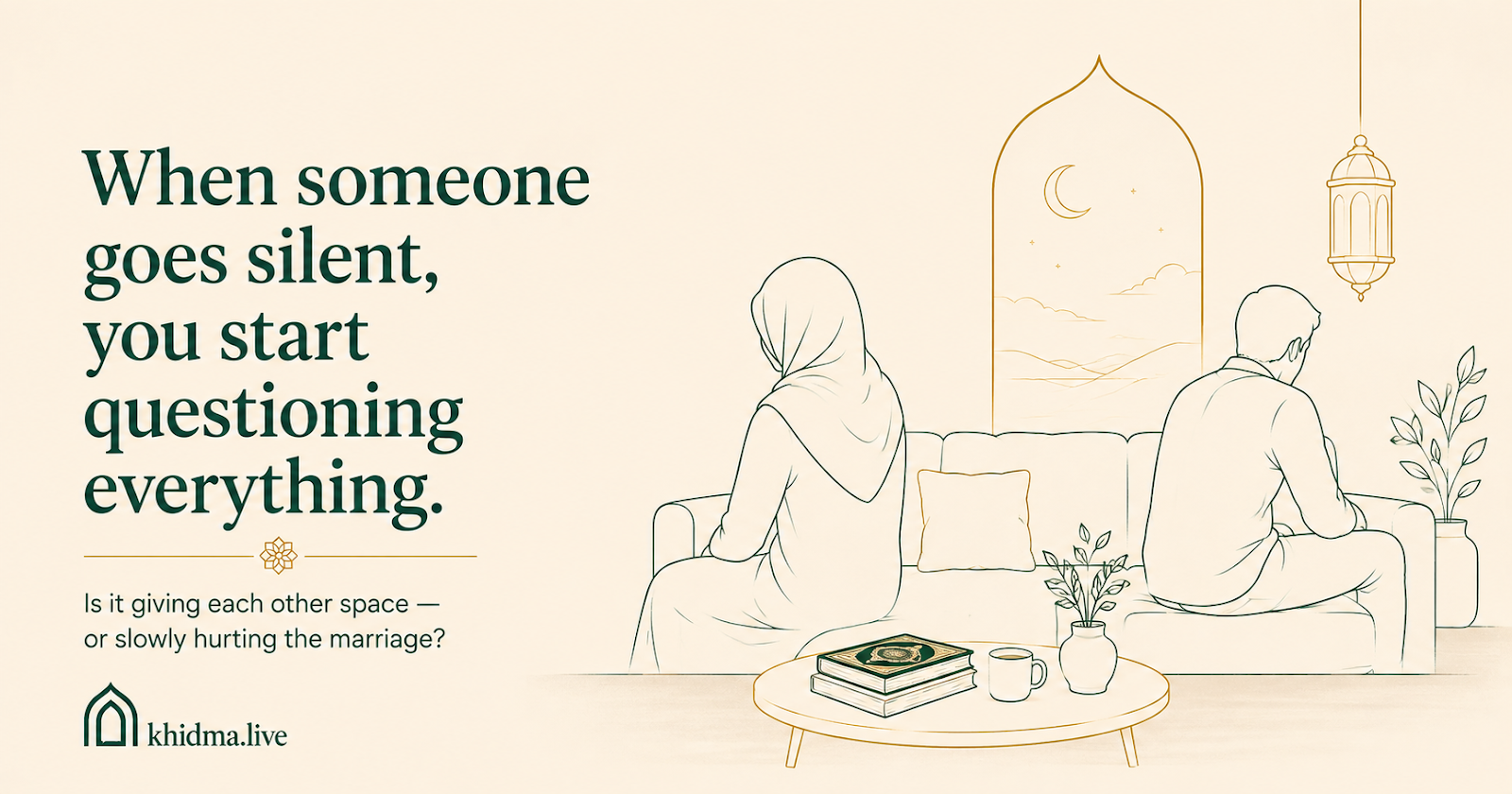
Marriage is meant to be a place of tranquility.
Allah says:
"And among His signs is that He created for you spouses from among yourselves that you may find tranquility in them; and He placed between you affection and mercy."
(Qur'an 30:21)
Yet for many Muslim women, marriage can begin to feel anything but tranquil.
Not because of shouting.
Not because of physical abuse.
But because of silence.
Days pass without meaningful conversation. Questions are met with one-word answers. Attempts to resolve conflict are ignored.Concerns are dismissed through withdrawal rather than discussion. And slowly, a wife begins to feel invisible inside her own marriage.
This is often called the silent treatment or stonewalling—and while it may appear less harmful than overt conflict, prolonged emotional withdrawal can have a profound psychological and spiritual impact.
What Is the Silent Treatment?
The silent treatment occurs when one spouse intentionally refuses to communicate, engage, or respond to the other.
It may look like:
- Ignoring attempts at conversation
- Withholding affection or emotional connection
- Walking away whenever difficult topics arise
- Refusing to address ongoing problems
- Creating emotional distance as a form of punishment
Not every period of silence is harmful.
People sometimes need time to cool down after disagreements.
The problem arises when silence becomes a pattern rather than a temporary pause.
When communication disappears for days, weeks, or even months, the marriage can become emotionally unsafe.
Why Silence Hurts So Much
Many women searching:
- husband won't talk to me islam
- silent treatment marriage islam
- emotionally unavailable husband islam
- lonely in marriage islam
often describe the same experience.
The silence creates uncertainty.
Unlike an argument, which at least provides information, silence leaves questions unanswered.
A wife may find herself wondering:
- Is he angry?
- Does he still care?
- Did I do something wrong?
- Is this marriage falling apart?
The mind naturally attempts to fill the gaps.
This can lead to:
- anxiety
- overthinking
- self-blame
- emotional exhaustion
- loss of confidence
Over time, some women begin walking on eggshells, avoiding conversations altogether to prevent further withdrawal.
The Psychological Impact of Stonewalling
Psychologists often describe stonewalling as one of the most damaging patterns within relationships.
Humans are created for connection.
When communication is consistently withheld, the nervous system can remain in a state of uncertainty and stress.
Many women report:
- difficulty sleeping
- constant rumination
- heightened anxiety
- emotional numbness
- feelings of rejection
The pain is often intensified when the husband appears perfectly normal with everyone else.
He can laugh with friends, speak kindly at work, and engage socially—yet remain emotionally unavailable at home.
This contradiction creates confusion and self-doubt.
What Does Islam Say About Communication in Marriage?
Islam does not expect spouses to agree on everything.
Conflict is natural.
What Islam emphasizes is how conflict is handled.
Allah says:
"Live with them in kindness."
(Qur'an 4:19)
Kindness is not limited to financial support.
It includes speech, behavior, emotional consideration, and respectful treatment.
The Prophet ﷺ was known for his gentleness with his wives.
He listened.
He reassured.
He communicated.
He did not use emotional withdrawal as a method of control.
The Prophet ﷺ said:
"The best of you are those who are best to their wives."
(Tirmidhi)
Being "best" includes how one communicates during moments of tension and disagreement.
Is the Silent Treatment Permissible in Islam?
Islam recognizes that people may need space to regulate emotions after conflict.
However, using prolonged silence to punish, control, or emotionally isolate a spouse contradicts the spirit of mercy and kindness that Islam seeks to establish within marriage.
Marriage is built upon:
- mercy (rahmah)
- affection (mawaddah)
- tranquility (sakinah)
These qualities cannot thrive where communication completely breaks down.
When silence becomes a tool of punishment, it often creates emotional harm rather than resolution.
How to Maintain Mental Grounding During Emotional Withdrawal
If you are experiencing prolonged silence from your spouse, maintaining your emotional and spiritual stability becomes essential.
1. Do Not Internalize Every Silence
A spouse's withdrawal often reflects their own communication patterns, emotional limitations, or coping mechanisms.
Not every silence is proof that you are at fault.
2. Stay Connected to Support
Isolation increases distress.
Trusted family members, scholars, counsellors, and qualified professionals can provide perspective and support.
3. Focus on What You Can Control
You cannot force another person to communicate.
You can control:
- your responses
- your boundaries
- your self-care
- your connection with Allah
4. Strengthen Your Spiritual Foundation
Allah says:
"Verily, in the remembrance of Allah do hearts find rest."
(Qur'an 13:28)
While dhikr does not replace practical solutions, it can help calm a heart overwhelmed by uncertainty.
5. Seek Clarity Rather Than Endless Guessing
Many women spend months or years trying to interpret silence.
Sometimes what is needed is not more guessing—but qualified guidance.
When Should You Seek Help?
If communication has broken down repeatedly and the emotional impact is becoming significant, seeking support is a wise step.
Questions worth exploring include:
- Is this temporary conflict or a long-term pattern?
- Has emotional neglect become chronic?
- Are Islamic rights being fulfilled?
- What healthy boundaries should exist?
- Is reconciliation realistically possible?
These questions deserve thoughtful answers rooted in both Islamic principles and emotional wellbeing.
How Khidma Helps
At Khidma, we regularly hear from women navigating emotional neglect, prolonged silence, and communication breakdowns in marriage.
Many are not looking for immediate divorce or drastic decisions.
They are looking for clarity.
Through private sessions with qualified Islamic scholars and Islamic psychologists, Khidma helps individuals understand:
- Islamic rights and responsibilities
- emotional neglect and relationship dynamics
- healthy communication and boundaries
- pathways toward reconciliation and healing
For women facing emotionally difficult marriages, our Light After Heaviness journey combines Islamic guidance and psychological support to help navigate challenges with wisdom, dignity, and clarity.
Final Thoughts
Silence can be powerful.
Sometimes it creates space for reflection.
But when silence becomes a pattern of avoidance, punishment, or emotional withdrawal, it can slowly erode the foundations of a marriage.
Islam encourages mercy, communication, and kindness between spouses.
If prolonged silence has left you feeling confused, isolated, or emotionally exhausted, know that seeking guidance is not a sign of weakness.
Often, the first step toward healing begins with understanding what Islam teaches—and finding the support needed to move forward with clarity.
Silence rarely appears on its own. It usually grows in a marriage where several smaller habits have been left unaddressed for years — unspoken resentment, decisions made unilaterally, conflict aired to family. For a full picture of what Islam actually asks of both spouses day to day, read our guide to practical Islamic marriage advice.
Check out our other blogs. https://khidma.live/blog/the-reality-of-marriage-in-islam-love-unity-and-letting-go-of-ego
https://khidma.live/blog/the-global-muslim-divorce-crisis-nobody-is-talking-about-by-team-khidma
And where the silence has followed words said in anger — including talaq — there is a prior question that needs answering first: is my nikah still valid?
Where the silence sits alongside other patterns — criticism, control, or being made to doubt your own memory of events — the question becomes a different one. Read: is emotional abuse haram in Islam.
Where withdrawal follows a betrayal rather than an argument, this is the more relevant guide.
About Khidma.live
Khidma.live connects Muslims with verified Islamic scholars — graduates of Masjid al-Haram in Makkah and Madinah University — and certified Muslim psychologists, for private one-to-one guidance. Founded by ADeeb Sayeed, whose work building Khidma.live was featured by Startup Muslim.
If the difficulty is ongoing rather than a single incident, our Islamic marriage guidance sessions connect you with a scholar or counsellor who works on [marriage specifically.](https://khidma.live/marriage)
For couples where the silence has settled in permanently — and where children are the reason the marriage continues — the question becomes a different one. Read: staying in a loveless marriage for the children.