Navigating Emotional Neglect in a Muslim Marriage: Feeling Lonely in Marriage? Islamic Perspective on Emotional Neglect
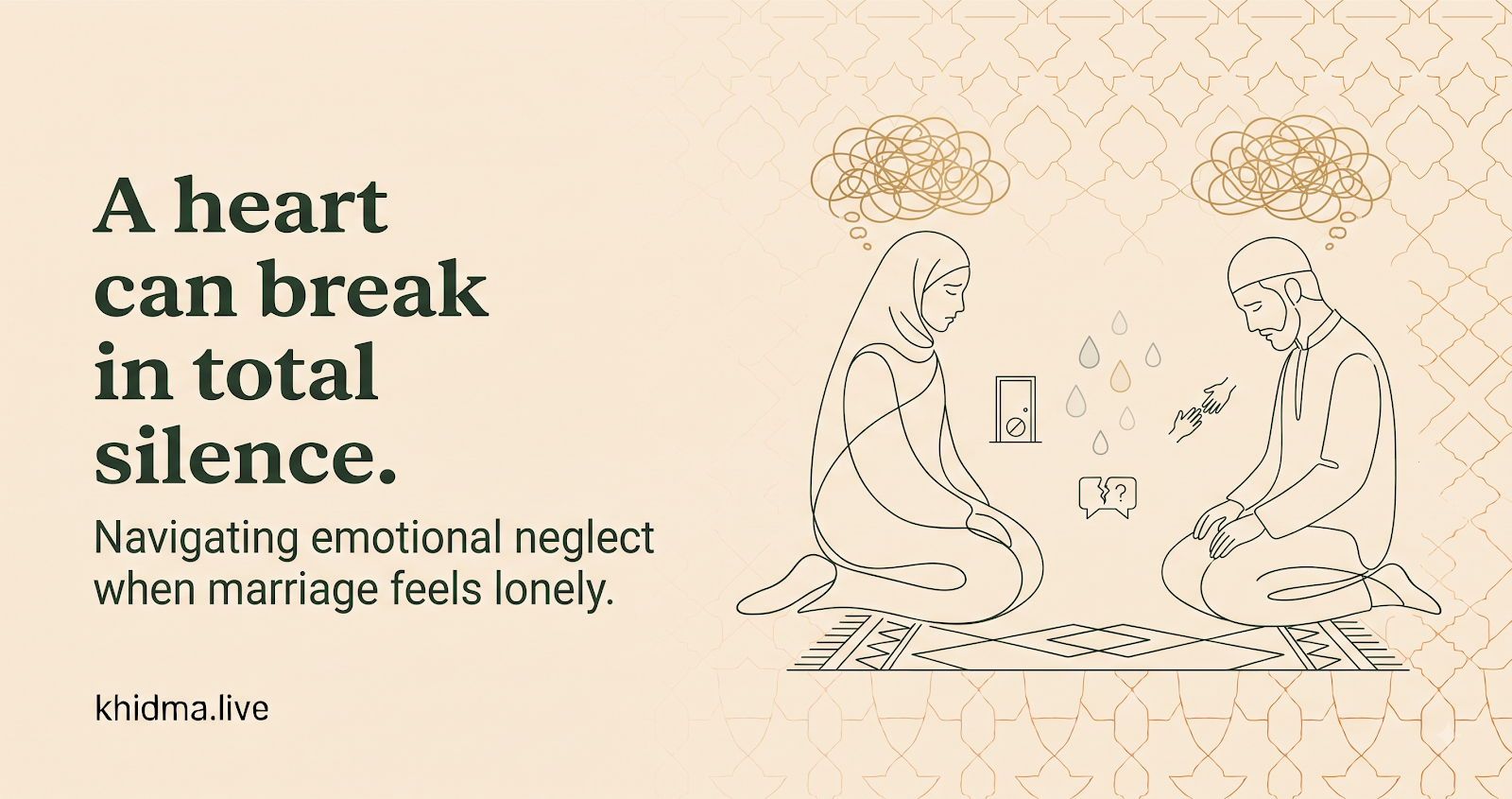
There’s a particular kind of loneliness that many Muslim women struggle to explain.
It’s the loneliness of being married to a man everyone else admires.
He’s respected in the masjid. Helpful to friends. Soft-spoken with strangers. Active in the community. Maybe even known as “religious.”
But at home, the warmth disappears.
Conversations feel cold. Affection feels transactional. Emotional needs are dismissed. Concerns are met with silence, defensiveness, or guilt. And over time, a wife begins to question herself:
“Maybe I’m asking for too much.” “Maybe this is just marriage.” “Maybe I need more sabr.”
This emotional confusion is real — and deeply painful.
Why Some Husbands Seem Kind Publicly but Distant at Home
One of the most difficult parts of emotional neglect in Muslim marriages is the double persona.
A husband may appear compassionate and righteous publicly while being emotionally unavailable, manipulative, dismissive, or harsh privately.
This creates what psychologists call cognitive dissonance — the mental and emotional tension of experiencing two opposite realities at once.
You see how gently he treats others. You hear people praise his character. Yet inside the marriage, you feel unseen and emotionally unsafe.
That contradiction can make women doubt their own experiences.
Especially in Muslim communities where religious appearance is often equated with emotional maturity.
But Islam does not measure righteousness by public image alone.
The Prophet ﷺ said:
“The best of you are those who are best to their wives.” — Tirmidhi
Not the best to the community. Not the best online. Not the most publicly admired.
The best are those who embody mercy, gentleness, patience, and dignity inside the home.
Emotional Neglect Is Not “Just a Personality”
Many women searching phrases like:
- husband ignores me islam
- lonely in marriage islam
- husband nice to everyone else but me islam
are not necessarily dealing with dramatic abuse.
Sometimes the wound is quieter.
It looks like:
- Constant emotional dismissal
- Never feeling listened to
- Lack of affection or reassurance
- Being mocked for expressing emotions
- Emotional withdrawal during conflict
- Feeling like a burden for having needs
- Being told to “just do sabr” whenever concerns are raised
Over time, emotional neglect chips away at a person’s self-worth.
A woman may continue fulfilling responsibilities outwardly while internally feeling emotionally abandoned.
And because there are no bruises, many struggle to validate their own pain.
Islam Does Not Ask Women to Disappear Emotionally
Sabr in Islam does not mean tolerating indefinite emotional harm without wisdom, support, or reflection.
Nor does leadership in marriage mean emotional domination.
Allah describes marriage as a source of:
tranquility (sakinah) love (mawaddah) mercy (rahmah)
These are emotional realities — not just financial or logistical ones.
The Prophet ﷺ listened attentively to his wives, comforted them emotionally, reassured them verbally, and treated them with gentleness.
Emotional care is not a “modern expectation.” It is deeply rooted in Prophetic character.
Signs of Manipulation Can Be Difficult to Recognize
Some women begin searching:
signs of manipulative husband in islam because they feel perpetually confused in their marriage.
Manipulation is not always loud or obvious.
Sometimes it appears as:
Making a wife feel guilty for expressing hurt Twisting conversations until she questions herself Using religion selectively to silence concerns Publicly appearing righteous while privately dismissive Refusing accountability but expecting obedience
These dynamics can leave women emotionally exhausted and spiritually conflicted.
Especially when they deeply want to preserve the marriage.
Seeking Help Is Not Betrayal
Many Muslim women suffer in silence because they fear: being judged, “exposing” their marriage, or appearing ungrateful.
But seeking guidance is not betrayal.
Islam encourages consultation, wisdom, and justice.
Sometimes clarity requires speaking to someone qualified — someone who understands both:
Islamic principles and emotional wellbeing
Not every marriage needs immediate separation. Not every difficult situation should be endured indefinitely without support either.
What’s needed first is clarity.
The Light After Heaviness: A Guided Path Forward
At Khidma, many women come forward carrying years of confusion, guilt, emotional exhaustion, and loneliness.
That’s why we created The Light After Heaviness — a private 3-session journey combining Islamic scholarship and psychology.
Session 1 — Individual + Scholar
Gain clarity on:
Islamic rights and responsibilities emotional harm and dignity in marriage removing guilt around seeking help or considering change Session 2 — Individual + Islamic Psychologist
Process:
emotional burnout chronic stress overthinking emotional dependency and exhaustion Session 3 — Individual/Couple + Islamic Psychologist
Create a practical roadmap forward with emotional and spiritual clarity.
Whether that path leads toward reconciliation, boundaries, healing, or difficult decisions — the goal is to move with wisdom, sincerity, and stability.
Emotional Neglect in Marriage: What Islam Says
A marriage can look perfect to the world while feeling painfully lonely behind closed doors.
And sometimes, the hardest part is not the pain itself — but feeling like no one would believe it because “he’s such a good person.”
But Allah sees what happens in private too.
Your emotional wellbeing matters. Your dignity matters. Your voice matters.
And asking for guidance is not weakness. It may be the first step toward healing.
Ask a scholar your question — free → Custody depends on your school, your children's ages and your circumstances. Send the details and a named, verified scholar records a private audio answer — no payment, no obligation.
Read: Khula in Islam → The route a wife can initiate, and what grounds are recognised.
Take the free Nafs Assessment → A private few minutes to understand what you are carrying, and who is right to speak to.
About Khidma.live
Khidma.live connects Muslims with verified Islamic scholars — graduates of Masjid al-Haram in Makkah and Madinah University — and certified Muslim psychologists, for private one-to-one guidance. Founded by ADeeb Sayeed, whose work building Khidma.live was featured by Startup Muslim.