Is Emotional Neglect Grounds for Khula? An Islamic Perspective on Emotional Harm in Marriage
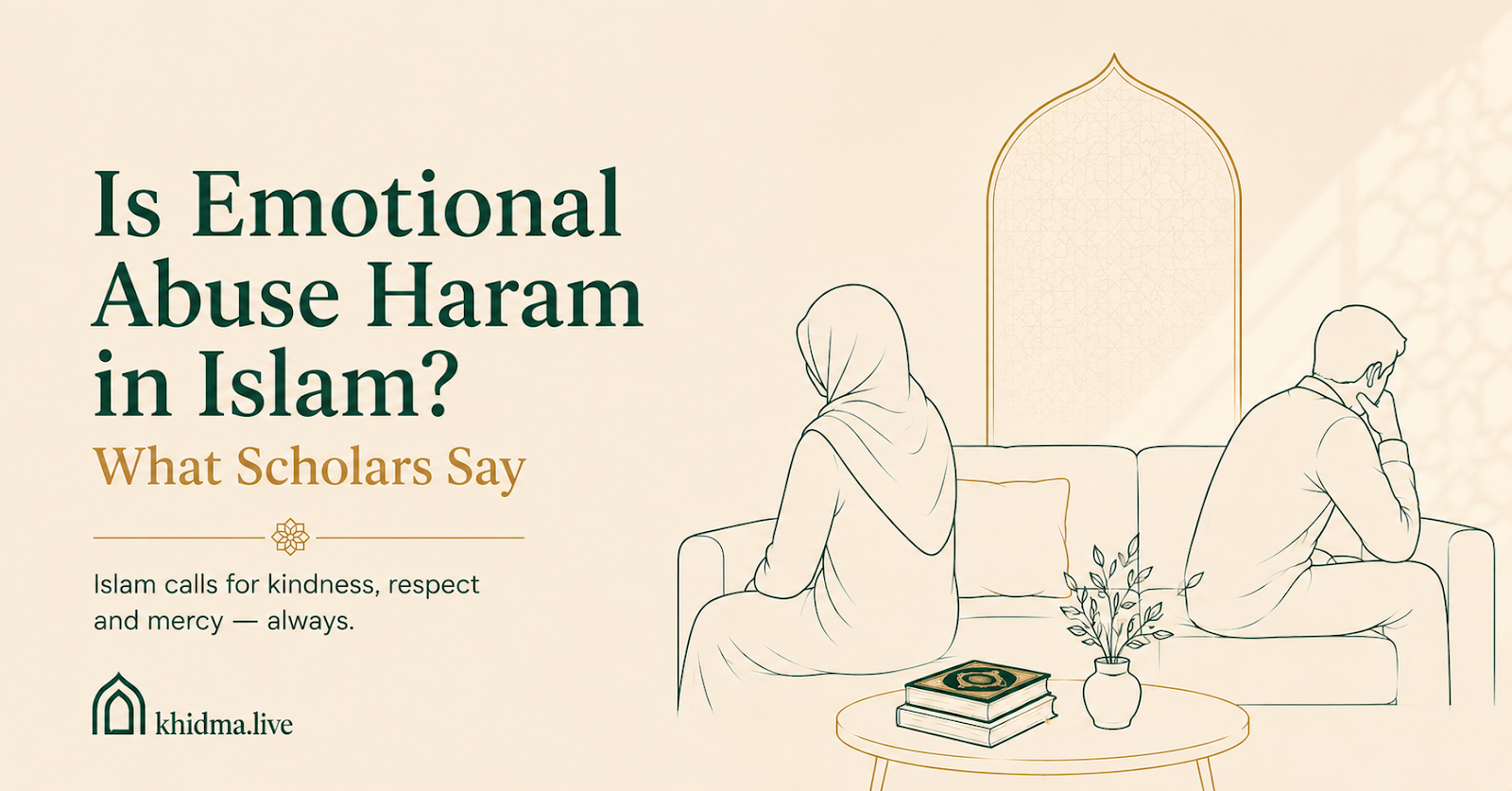
Many Muslim women quietly live with a question they feel guilty even thinking about:
“Nothing dramatic is happening… but why does this marriage feel emotionally painful?”
There may be no physical abuse. No public scandal. No obvious crisis. But inside the home, there is distance, coldness, dismissal, emotional exhaustion, and loneliness.
For some women, this eventually leads to another difficult question:
“Is emotional neglect enough reason to seek khula in Islam?”
This question deserves a sincere, nuanced, and compassionate answer — not shame, dismissal, or oversimplified advice.
What Is Emotional Neglect in Marriage?
Emotional neglect happens when emotional needs are consistently ignored, dismissed, or minimized within a relationship.
In marriage, it can look like:
- Constant emotional distance
- Lack of affection or reassurance
- Feeling unseen or unheard
- Dismissive responses during emotional conversations
- Silent treatment or emotional withdrawal
- Being made to feel “too emotional”
- Feeling lonely despite being married
Many women searching:
- husband ignores me islam
- lonely in marriage islam
- emotionally unavailable husband islam
are often experiencing some form of emotional neglect.
And because emotional harm leaves no visible scars, many struggle to validate their own pain.
Does Islam Recognize Emotional Harm in Marriage?
Yes.
Islam does not reduce marriage to financial provision or outward appearances alone.
Allah describes marriage as:
- tranquility (sakinah)
- love (mawaddah)
- mercy (rahmah)
These are deeply emotional qualities.
The Prophet ﷺ was emotionally attentive, gentle, affectionate, and compassionate toward his wives. He listened to them, comforted them, reassured them, and treated them with dignity.
He ﷺ said:
“The best of you are those who are best to their wives.” — Tirmidhi
This includes emotional treatment — not just physical or financial responsibilities.
Is emotional neglect enough? What the scholars hold
Yes. Emotional neglect and psychological distress are recognised grounds for seeking khula.
Islamic law treats marriage as founded on affection, tranquillity and honourable treatment. Where neglect or deep incompatibility makes that impossible, khula exists precisely as a protection for the wife — not as a loophole she has to justify her way into.
The Qur'anic basis
"And if you fear that they will not keep within the limits of Allah, there is no blame upon either of them concerning that by which she ransoms herself." — al-Baqarah 2:229
Notice what the verse makes the trigger. Not cruelty. Not violence. The fear that the marriage can no longer be conducted within the limits Allah set for it.
The case the Prophet ﷺ decided
The wife of Thabit ibn Qays came to him and said she found no fault in Thabit's character or his religion — but that she feared kufr, meaning she feared failing in what the marriage required of her.
"Will you return his garden to him?"
She said yes. She returned it, and he ordered Thabit to separate from her. — Sahih al-Bukhari [SHEIKH: number]
In another narration she said plainly: "I cannot bear him out of aversion."
He granted it without requiring proof of violence or misconduct. She had no allegation to make. She was not asked to establish harm. Intense emotional aversion and the inability to live affectionately were treated as sufficient in themselves.
That is the precedent. It is not a marginal opinion.
"A woman who asks for divorce without reason..."
You have probably had this quoted at you:
"Whichever woman asks her husband for a divorce without any legitimate reason (ba's), the fragrance of Paradise is forbidden to her." — Recorded by Abu Dawud and al-Tirmidhi [SHEIKH: numbers and grading]
The word doing all the work is ba's — legitimate harm or reason. The narration does not forbid a woman from leaving. It forbids leaving for nothing.
And scholars hold that emotional neglect, chronic coldness, hostility and deep emotional incompatibility fall within ba's. Two reasons are given:
Fear of sin. Emotional estrangement leads to resentment and to an inability to fulfil reciprocal marital duties — which is precisely the condition the Qur'an names as fearing you cannot keep within Allah's limits.
The obligation on him. Sustained emotional abandonment (i'rād) violates a direct command:
"Either retain in an honourable manner, or release with kindness." — al-Baqarah 2:229
There is no third option in that verse. A man who neither treats his wife honourably nor releases her is outside what the verse permits — and the hadith about ba's is not a licence for him to keep her there.
Khula or judicial dissolution — two different routes
If emotional harm is present, there are two distinct paths, and which one applies changes what it costs you.
Khula — release by compensation. If you want to end the marriage because you cannot emotionally sustain it, even where he is not actively malicious, you may offer to return your mahr or agreed compensation in exchange for release.
Tafriq li al-darar — judicial dissolution for harm. Where a husband deliberately causes severe psychological harm, emotionally abuses, or abandons his wife while withholding her rights in order to force her into surrendering her financial entitlements, that coercion ('adl) is itself prohibited. Under Maliki jurisprudence and in widely adopted family law codes, a judge may dissolve the marriage on grounds of harm while preserving her full financial rights.
That distinction matters practically. A woman pushed into khula by a husband deliberately making her life unbearable may be giving up mahr she would not have to surrender under the second route. Which applies to you depends on facts a scholar needs to hear.
In short
Islamic law does not require anyone to remain in a marriage that causes emotional degradation, spiritual distress, or the inability to live with mutual kindness. Whether your circumstances meet the threshold, and which of the two routes fits them, is a question for a qualified scholar who can hear the specifics.
Questions like:
- Is this emotional neglect?
- Are my rights being ignored?
- Is reconciliation realistically possible?
- What does Islam actually say about this situation?
- What healthy boundaries look like?
- How do I separate guilt from sincerity?
These questions deserve thoughtful answers from qualified people who understand both:
Islamic scholarship and emotional wellbeing The Light After Heaviness: Faith-Based Support for Difficult Marriages
At Khidma, many women come forward carrying years of emotional exhaustion, confusion, and loneliness.
That’s why we created The Light After Heaviness — a guided 3-session journey combining Islamic guidance and psychology.
Session 1 — Wife Individual + Scholar
Understand:
- Islamic rights
- emotional harm in marriage
- clarity around difficult decisions
- removing guilt and confusion
Session 2 — Husband + Islamic Psychologist
Process:
- burnout
- emotional exhaustion
- anxiety and overthinking
- emotional dependency and stress
Session 3 — Individual/Couples + Islamic Psychologist
Build a roadmap forward rooted in:
- emotional wellbeing
- Islamic values
- clarity and stability
The goal is not to push separation or force reconciliation.
The goal is to help people move forward with wisdom, sincerity, and emotional clarity.
Final Thoughts
Not every difficult marriage requires khula.
But not every emotionally painful marriage should be minimized either.
Islam honors emotional dignity. Islam values mercy within marriage. And Islam encourages seeking guidance with wisdom and sincerity.
If a marriage has become a source of chronic emotional harm, confusion, or emotional isolation, seeking help is not weakness.
Sometimes clarity is the first step toward healing whether together or apart.
At Khidma.live, women can privately speak with verified Islamic scholars and Islamic psychologists about:
emotional neglect, marital confusion, Islamic rights, reconciliation, and difficult marriage decisions.
Explore the “Light After Heaviness” guided support journey for women navigating emotionally difficult marriages.