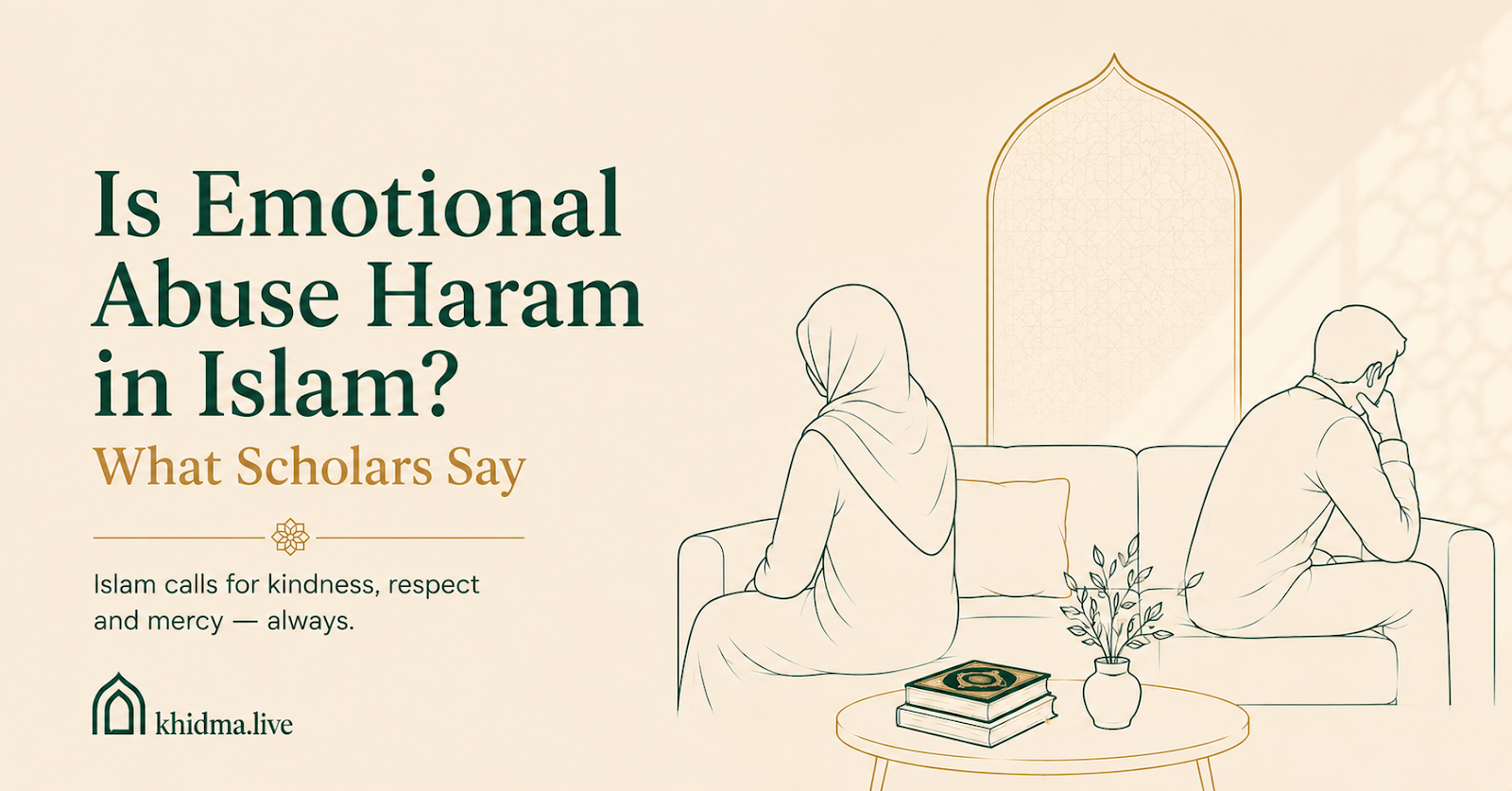
There is a particular kind of doubt that keeps Muslim women silent for years.
He has never raised a hand. There is no bruise to point to, nothing anyone would recognise as a reason to complain. But she is criticised until she stops speaking. Her memory of events is corrected until she no longer trusts it. She is punished with silence for days. She is told, when she objects, that she is being dramatic, ungrateful, or a bad Muslim wife.
And underneath it all: is this even something Islam would consider wrong, or am I just failing at sabr?
That question deserves a direct answer.
The Short Answer
Yes. What is commonly called emotional abuse is haram where it involves unjust harm — repeated humiliation, insults, ridicule, degrading names, intimidation, false accusations, or deliberately causing emotional distress.
This is not a modern reinterpretation. The Kuwaiti Fiqh Encyclopedia classifies humiliating and verbally harming another person as forbidden, and some scholars regarded such harm as a major sin.
Being a husband confers responsibilities toward a wife. It does not confer permission to harm her.
The Evidence
The Quran prohibits unjust harm to believers
"Those who unjustifiably harm believing men and women bear the guilt of slander and blatant sin." (Surah al-Ahzab, 33:58)
The verse addresses harm itself — not a particular method of inflicting it. It does not distinguish between a blow and a campaign of humiliation, and it carries no exemption for harm inflicted within a household.
The Quran prohibits mockery, defamation and degrading names
"Believers, let no people ridicule another people, who may be better than them; nor women ridicule other women, who may be better than them. Do not defame one another, nor call one another by offensive nicknames." (Surah al-Hujurat, 49:11)
Ridicule, fault-finding and degrading names are named directly. These are among the most common features of emotional abuse in a marriage, and the Quran addresses them explicitly.
The Prophet ﷺ defined a Muslim by the safety of others from him
"A Muslim is one from whose tongue and hand other Muslims are safe."
Note the order. The tongue is named alongside the hand — harm through words is placed beside harm through actions, not beneath it.
And Islamic legal reasoning holds that harm is neither to be inflicted nor reciprocated
This maxim is foundational in Islamic jurisprudence and a great deal of Islamic law is derived from it. It contains no exception for what happens inside a home.
Within Marriage Specifically
"And live with them honourably." (Surah An-Nisa, 4:19)
Classical commentators — including in Tafsir al-Manar — explain that verbal harm, harsh speech and persistent hostile treatment directly contradict living together honourably. The command is not merely to avoid physical harm. It sets a standard of conduct that sustained cruelty fails by definition.
The Prophet ﷺ set that standard higher still. He said the best of people are those best to their families. In his own household he never struck a woman or a servant, and was known for gentleness with his wives even in disagreement.
Being a spouse, a parent, or a person in authority does not make emotional harm permissible. If anything, the obligation of kindness is heightened where the relationship is closest.
What Emotional Abuse Actually Looks Like
Emotional abuse is difficult to name partly because no single incident looks decisive. It is a pattern, and patterns are hard to see from inside.
Some of the forms most often described by Muslim women seeking guidance:
Persistent belittling. Criticism of her appearance, intelligence, cooking, family or worship — sustained until she believes it. Directly addressed in al-Hujurat 49:11.
Denying her reality. Being told events did not happen as she remembers, that she is imagining things, that she is too sensitive — until she stops trusting her own account of her life.
Punishment through withdrawal. Days of deliberate silence used to enforce compliance. Where silence is used as a weapon rather than a pause, Islam has something specific to say about it.
Isolation. Restricting her contact with parents, siblings and friends — often framed as protection. Maintaining family ties is an obligation Islam places on her, not a privilege he grants.
Financial control. Taking her income, withholding provision, or making money a lever of compliance.
Threats. Divorce, taking the children, or a second marriage used to end conversations rather than as genuine intentions.
Weaponising the deen. Verses about obedience quoted while the corresponding obligations on him are never mentioned. Her religious objections dismissed. Her worship criticised. Selective use of religious text to secure compliance is a misuse of Islamic knowledge, not an application of it.
Contempt. Mockery, eye-rolling, dismissal — the steady communication that she is beneath consideration.
Conflict Is Not Abuse — Here Is the Difference
This distinction matters, and getting it wrong in either direction causes harm.
Every marriage has conflict. Spouses argue, say things they regret, withdraw when overwhelmed, and fail each other. The Prophet ﷺ and his wives had moments of friction. Ordinary marital difficulty is not abuse, and treating it as such damages marriages that could be repaired.
What distinguishes abuse is pattern, power and direction.
Conflict is two people struggling with a problem. Abuse is one person systematically diminishing the other. In conflict, both feel bad afterwards and both want repair. In abuse, one is consistently the one apologising, shrinking, and managing the other's moods.
The most reliable question is not what did he do? It is what has happened to me? Someone in ordinary marital difficulty is unhappy. Someone being abused has begun to disappear — walking on eggshells, doubting her own memory, apologising for things she did not do, and no longer recognising herself.
The Question of Sabr
This is where many Muslim women become trapped, and it needs saying plainly.
Sabr does not mean enduring harm indefinitely.
Patience is among the most dignified stations in Islam, and it is genuinely called for in marriage. Every marriage passes through hard seasons that patience carries a couple through.
But there is a difference between sabr as active perseverance — bearing difficulty while working toward repair, seeking help, holding hope — and sabr as resignation, silently absorbing damage year after year because you believe Islam requires it of you.
Islam asks for the first. It never asked for the second.
The Quran's own guidance on marital discord is not endurance. It prescribes action: bringing in qualified arbiters from both sides to address the situation (Surah An-Nisa, 4:35). That is the opposite of suffering quietly.
If sabr has been used to keep you silent about being harmed, that is not Islam's sabr. That is a cultural expectation wearing a Quranic word.
What Islam Does Not Require of You
Some things worth stating without qualification:
You are not required to obey an instruction that harms you. Obedience in Islam has never been unconditional, and it does not extend to your own damage.
You are not required to pretend that injustice is acceptable. Seeking help from trustworthy relatives, a qualified imam, or a counsellor is consistent with the Islamic duty to support someone who is being wronged — not a violation of it.
You are not required to keep it entirely to yourself. Islam discourages exposing a spouse's faults casually or publicly. It does not require silence toward someone qualified to help. The Quranic model of arbitration assumes disclosure.
You are not required to accept that this is your test to bear alone. Hardship is a test. So is what you do about it.
You are not being a bad Muslim wife for finding this unbearable. Recognising harm is not ingratitude.
What Repentance Actually Requires From Him
For the sake of completeness — and because some readers will be the ones who have caused harm rather than received it — this is worth stating clearly.
Where someone has committed emotional harm, the conditions of repentance in Islamic teaching are specific:
- Stopping the behaviour entirely
- Genuine regret for what was done
- A firm resolve not to return to it
- Addressing the rights of the person harmed — normally by seeking her forgiveness and repairing the damage
That last condition is the one most often skipped. Harm to another person involves a right owed to them, not only to Allah. Private istighfar without acknowledgement to the wife who was harmed does not discharge it.
This is also why "he apologised and said he's changed" is not, on its own, sufficient evidence of change. Repentance from harm is measured in sustained behaviour, not in a statement.
Where This Leaves You
An article can establish that emotional abuse is impermissible in Islam. What it cannot do is tell you what your marriage is, or what you should do about it.
Whether a specific situation constitutes harm in the Islamic sense, what obligations have been breached, and what recourse exists — including questions of separation or khula — depends on details only you can supply and only a qualified scholar can assess.
Two things are usually needed together.
A verified Islamic scholar can tell you what Islam actually establishes about your situation. For many women this is the piece that changes everything, because the doubt itself — am I even allowed to call this wrong — is what has kept them silent. And a husband will often accept from a qualified scholar what he will not accept from his wife.
A certified Muslim psychologist addresses what a ruling alone cannot: the erosion of confidence, the self-doubt, the exhaustion. Support that treats your faith as a foundation rather than a symptom matters enormously here, because a therapist without Islamic literacy may misread your reasons for staying as a problem to be corrected.
Neither requires you to have decided anything. Many women seek clarity long before they decide what to do with it — and there is no obligation to involve your husband, or anyone in your family, in order to ask.
Frequently Asked Questions
1. Is emotional abuse haram in Islam?
Yes, where it involves unjust harm — humiliation, insults, ridicule, degrading names, intimidation, false accusations, or deliberately causing distress. The Quran prohibits unjustly harming believers (al-Ahzab 33:58) and forbids mockery, defamation and offensive names (al-Hujurat 49:11). The Kuwaiti Fiqh Encyclopedia classifies humiliating and verbally harming another as forbidden.
2. Does Islam only prohibit physical abuse?
No. The Prophet ﷺ said a Muslim is one from whose tongue and hand others are safe — naming verbal harm alongside physical. The Quranic command to live with wives honourably (An-Nisa 4:19) is explained by commentators as excluding verbal harm, harsh speech and persistent hostile treatment.
3. How do I know if it's abuse or just a difficult marriage?
The distinguishing features are pattern, power and direction. Conflict is two people struggling with a problem; abuse is one person systematically diminishing the other. A useful question is not what he did, but what has happened to you — whether you have begun walking on eggshells, doubting your own memory, or apologising for things you did not do.
4. Does sabr mean I have to endure this?
No. Sabr means active perseverance — bearing difficulty while seeking resolution — not indefinite silent endurance of harm. The Quran's own guidance for marital discord prescribes bringing in qualified arbiters (An-Nisa 4:35), which is action rather than endurance.
5. Is it backbiting to tell someone what is happening?
Islam discourages exposing a spouse's faults casually. Seeking help from trustworthy relatives, a qualified imam or a counsellor is consistent with the Islamic duty to support someone being wronged. You are not religiously required to pretend that injustice is acceptable.
6. My husband quotes Quran and hadith to justify how he treats me. Is that valid?
Quoting verses about obedience while ignoring the obligations Islam places on husbands is selective use, not application. The same Quran that discusses marital roles commands living with wives honourably and prohibits ridicule and defamation. A verified scholar can examine what the texts actually establish in your specific situation.
7. Is emotional abuse grounds for khula or separation?
Islamic jurisprudence recognises harm as a serious matter, and scholars have discussed the recourse available where harm is established. Whether it applies to a particular situation depends on the specifics and requires assessment by a qualified scholar. See also: is emotional neglect grounds for khula.
8. Can a marriage recover from emotional abuse?
Sometimes, but only under specific conditions. Repentance from harm requires stopping the behaviour, genuine regret, firm resolve not to repeat it, and addressing the rights of the person harmed — which means seeking her forgiveness and repairing the damage, not only private istighfar. An apology alone is not evidence of change; sustained behaviour is.
9. Can I speak to a scholar without my husband knowing?
Yes. Sessions on Khidma.live are completely private and confidential. Many women seek clarity on their situation before deciding whether or how to raise anything with their spouse or family.
10. What if I am not ready to do anything about it?
That is common and understandable. Understanding what Islam actually says about your situation costs nothing and commits you to nothing. You can ask a scholar a question for free without deciding anything at all.
You Were Never Required to Carry This Quietly
The most damaging part of emotional abuse in a Muslim marriage is often not the behaviour itself. It is the belief — absorbed from culture, and sometimes enforced with religious language — that enduring it silently is what faith requires.
It isn't. The Quran prohibits unjustly harming believers. It forbids ridicule and degrading names. It commands living with wives honourably. And when a marriage falls into discord, it prescribes bringing in qualified help.
Every one of those points in the opposite direction from silence.
You do not need to have decided anything to ask what your situation actually is.
Khidma.live connects Muslims with verified Islamic scholars trained at Masjid al-Haram and Madinah University and certified Muslim psychologists — privately and confidentially, across the United Kingdom, United Arab Emirates, and United States
By Team Khidma · Reviewed by Sheikh Abdur Rehman Haran and Zulekha Shakoor Rajani
Betrayal sits alongside these patterns and raises the same question of whether a wife must endure it. We cover that in what Islam says about a husband who has cheated.
If you are in immediate danger, please contact your local domestic abuse services or emergency services first.*
Ask your first question — free →