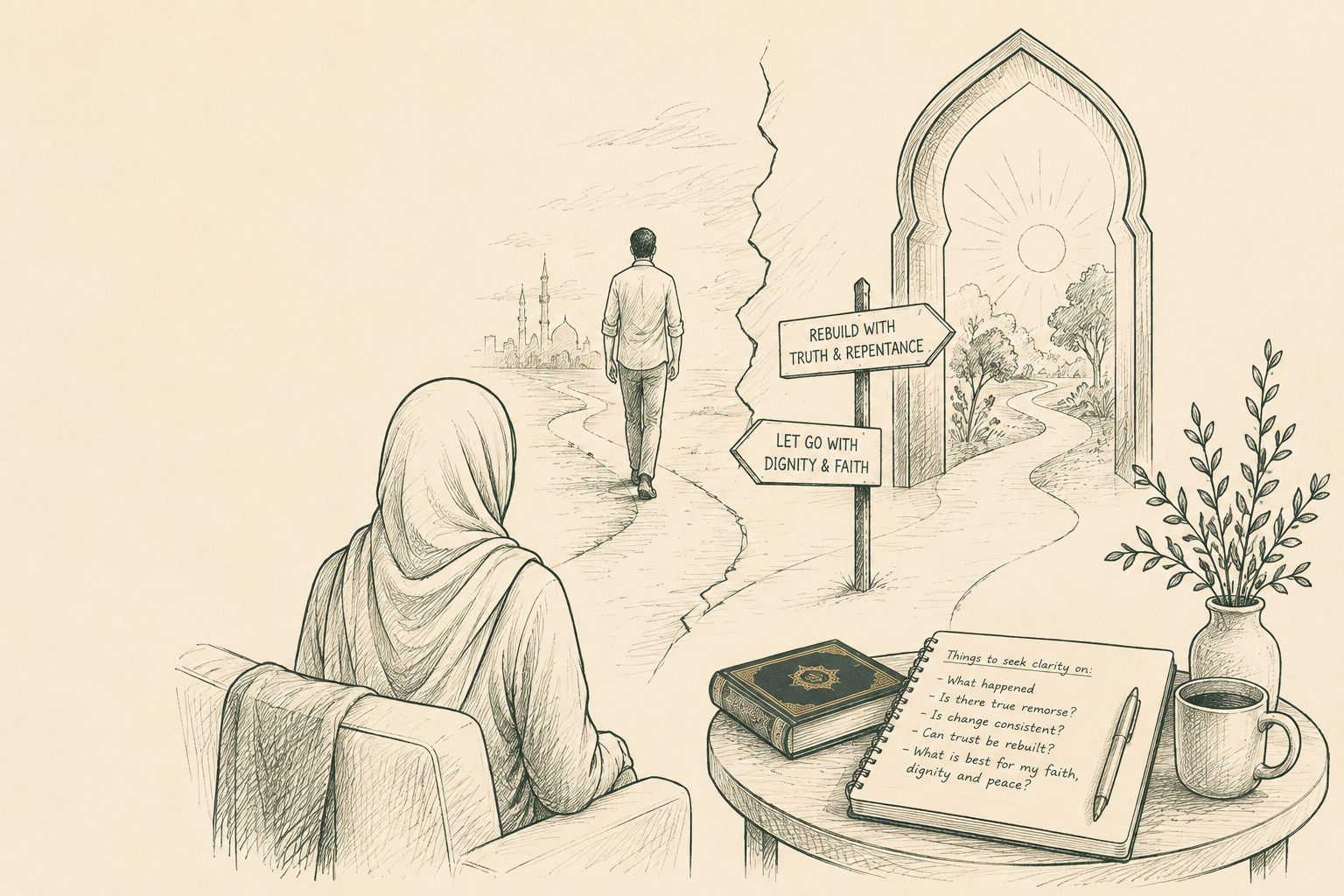
By Team Khidma
He has said it's finished. He has deleted the number, cried, promised, perhaps involved his mother or yours. And you are lying awake at 3am trying to work out whether any of it is true.
The exhausting part isn't the betrayal. It's the not knowing — checking his phone and hating yourself for it, reading meaning into how long he takes to reply, feeling foolish for believing him and equally foolish for not.
Most women who write to us about this are not asking how to rebuild. They are on the second time, or the third. They have already forgiven once.
What Islam says about what he did
You may have been told this is a private matter, or that men are like this, or that raising it damages the marriage more than the act did.
The Qur'an is not ambiguous:
"And do not approach unlawful sexual intercourse. Indeed, it is ever an immorality and is evil as a way." — al-Isra 17:32
The prohibition is not only of the act but of approaching it — the messages, the meetings, the private closeness that precedes it. A husband who insists nothing physical happened has not answered the question the verse asks.
And the Prophet ﷺ described what happens to faith in that moment:
"The adulterer is not a believer at the time he commits adultery, nor is the thief a believer at the time he steals, nor is the wine-drinker a believer at the time he drinks wine." — Narrated by Abu Hurayrah. Recorded in Sahih al-Bukhari and Sahih Muslim
He is not, by this, outside Islam. The narration describes what happens to faith in the moment of a major sin, and it places zina alongside theft and intoxication rather than singling it out. But it makes something clear that women in this position are often told the opposite of: this is not a lapse of judgement or a male weakness to be absorbed. It is treated in the Sunnah as a sin that suspends faith while it is being committed.
This is worth stating plainly for one reason. Women in this situation are frequently made to feel that their reaction is excessive — that they are being dramatic, unforgiving, or worldly. What he did is treated in the Qur'an as among the gravest violations. Your response to it is proportionate.
Does his infidelity end the marriage?
No — not by itself.
The general consensus among scholars is that an act of adultery does not automatically annul or dissolve the marriage contract. The nikah stands. You are not divorced by what he did, and you have not become unlawful to him.
That matters practically, because women often assume one of two wrong things: either that the marriage has already ended, or that because it hasn't, they are obliged to continue it.
Neither is right. The marriage continues, and you have the full religious right to seek its end — through talaq or khula — on the grounds of moral corruption and harm.
So the decision is genuinely yours. You are not sinful if you stay and try to help him reform. You are not sinful if you leave. Anyone telling you that one of those is the only religiously acceptable option is telling you something the scholars do not say.
If you are considering ending it, khula in Islam sets out the route a wife can initiate and what grounds are recognised.
Are you obliged to forgive him?
No. And this is the point most often misrepresented to women.
Islam holds repentance and the concealing of faults in very high regard. Allah's mercy is described in the widest possible terms:
"Say: O My servants who have transgressed against themselves, do not despair of the mercy of Allah. Indeed, Allah forgives all sins." — az-Zumar 39:53
"All the children of Adam err, and the best of those who err are those who repent." — Narrated by Anas ibn Malik. Recorded by al-Tirmidhi and Ibn Majah
If he has genuinely repented, granting a second chance is permissible and praiseworthy. That is real, and it is why so many women feel they should.
But here is the distinction that keeps getting collapsed. Allah's forgiveness of him is between him and Allah. It does not oblige you to resume trusting him.
Forgiveness is not a religious obligation on the wronged spouse. You may still choose separation if emotional reconciliation or trust is impossible. Not being able to trust him again is a legitimate basis for ending it — not a failure of your faith, not a shortage of sabr.
If someone has told you that forgiving him is required of you as a Muslim wife, that is not what the scholars hold.
"He says he's repented"
At some point he will tell you he has made tawbah. Often that is where the pressure on you begins — because if Allah has forgiven him, what right have you to keep holding it?
Two things need separating here, and almost nobody separates them.
What his repentance does. If it is sincere, it is genuinely accepted. Allah pairs zina with shirk and unlawful killing in Surah al-Furqan, and then immediately says:
"Except for those who repent, believe and do righteous work — for them Allah will replace their evil deeds with good." — al-Furqan 25:70
And the Prophet ﷺ said that one who repents from a sin is like one who has no sin. — Sunan Ibn Majah 4250; graded hasan
So a man who has genuinely repented is not permanently disgraced. That is real, and it matters.
What his repentance does not do. It does not oblige you to resume trusting him, and it does not oblige you to stay. His repentance is between him and Allah. Your decision about the marriage is a separate question, and forgiveness by Allah does not transfer to you as a duty.
Anyone who tells you that his tawbah settles your position has collapsed two different things into one.
The three conditions — and why they matter to you
Sincere repentance for this sin has three conditions, and none of them is an apology to you:
- Cessation — stopping the act and every path leading to it.
- Remorse. The Prophet ﷺ said: "Remorse is repentance." — Sunan Ibn Majah 4252; sahih
- Firm resolve never to return to it.
Read the first one again. Every path leading to it. A man who says he has repented while still working beside her, still following her, still travelling in the same circumstances that produced it, has not met the first condition — whatever he feels about it.
That is not you being suspicious. It is the condition itself.
"But he's done this before"
Many women are told that a man who repents and relapses was never sincere, or alternatively that his repeated tawbah obliges endless patience from them. Neither follows.
A prior sincere repentance stays valid for what came before it. A later relapse is a new sin needing fresh repentance — it does not resurrect what was already forgiven, and it does not mean the earlier tawbah was fraudulent.
"Allah accepts the repentance of a servant as long as he has not reached the death rattle." — Jami' at-Tirmidhi 3537; graded hasan
There is no limit on how many times Allah will forgive him.
There is no equivalent rule requiring you to. The door of repentance being open to him has never meant the door of the marriage must stay open to you. Those are two different doors, and only one of them is your responsibility.
What repeated relapse gives you is not a verdict on his sincerity. It is information about what is likely to happen next — which is a different thing, and the thing you are actually deciding on.
How to recognise real repentance — three tests
Trust cannot be rebuilt on promises. The scholars describe sincere repentance (tawbah nasuh) as having conditions, and they map almost exactly onto what a counsellor would look for:
1. Immediate cessation. The relationship ends completely — all contact, every channel, every avenue that led to it. Not reduced. Not "we still work together but it's professional." Severed.
2. Deep regret and accountability. Authentic remorse, not deflection or minimising. "It was only messages." "You were distant." "It didn't mean anything." Each of those is the opposite of what repentance requires.
3. Consistent reform over a sustained period. Re-establishing Islamic boundaries, fulfilling religious duties including prayer, and transparent conduct maintained over time — not for a fortnight.
That third condition is the one people skip. Sustained is doing the work in that sentence. A man can meet the first two conditions for three weeks. The question is what he looks like in month six.
Why "he seems really sorry" tells you nothing
Remorse and change are different, and after a betrayal they get confused constantly.
Remorse is a feeling about being caught. It is intense, usually sincere, and it fades. A man can weep at 11pm and be messaging her again the following month without having lied to you in the moment — he meant it. That is precisely the problem. What he felt is not evidence about what he will do.
Four things to watch instead:
Did he tell you, or did you find out? Disclosure after being caught is usually partial — the version that accounts for the evidence you already have, and no more. If every new detail has emerged only after you produced proof, you have not yet been told what happened.
Did he change things you didn't ask for? Genuine change shows up as him removing his own access — leaving a role, cutting contact at professional cost, volunteering his phone before you ask. Compliance with your rules is different. A man following instructions is managing you; a man who has decided something acts before he is told.
Can he tolerate your distress? Months later something will remind you and you will cry, or ask again, or need to go over it. "I've said sorry, what more do you want" — arriving early and repeatedly — signals that his priority is closing the subject rather than repairing what he broke.
Has the situation actually changed? If it happened with a colleague and he still works beside her, nothing structural has moved. If it happened during travel and the travel continues unchanged, nothing has moved. Circumstance matters more than intention.
When it has happened more than once
Most of the questions we receive about betrayal are not about the first time.
The scholarly position on repeated infidelity is markedly firmer than on a first offence. Where an unfaithful spouse persists in betrayal without reform, jurists state that separation becomes the recommended or necessary course — to prevent religious harm, physical harm including disease, and harm to the family.
That is a considerable distance from "have sabr."
The psychological reality points the same way. A first betrayal can genuinely be a catastrophic failure by a man who then changes. A repeat is better evidence — not because it is worse morally, but because you have now run the experiment. He was forgiven, he had the chance, and this is what happened.
The pressure usually intensifies at exactly this point. Families who counselled patience the first time counsel it harder the second, and the promises get bigger. You are entitled to weigh the second differently. Treating it as though it were the first is not patience; it is declining to look at your own evidence.
When there are children
Nearly a third of the questions we receive on this involve children, and it changes what women feel permitted to consider.
The scholars weigh it in both directions, and both are legitimate:
If he has genuinely repented, maintaining the household to protect children from family fracture and social disruption is a valid and praiseworthy consideration. Staying for the children is not a foolish reason.
If staying subjects the children to ongoing conflict, toxicity, or open immorality, separation may be the healthier course for their emotional and spiritual wellbeing.
Notice that the deciding factor in both is not the children — it is whether he has actually repented. That is the question to answer first, using the three tests above. The children's interest follows from it rather than overriding it.
What we would caution against is deciding under the assumption that only one of these is true. Both are.
"I gave him so many chances"
Many women reach a point of feeling stupid — for staying, for believing him, for the years.
You were not stupid. You were doing what a marriage requires you to do, which is extend trust to the person you married. That he exploited it is a fact about him. A woman who trusted her husband has not made an error of judgement; she has been deceived by someone holding far more information than she had.
The guilt about the checking is worth naming too. Reading his phone, tracking his movements, going through receipts — women describe this with real shame. It is not a character defect. It is what happens when your sense of reality has been contradicted by someone you relied on, and your mind starts trying to establish the facts for itself. It usually eases as evidence accumulates in one direction or the other. If it isn't easing after months, that is worth speaking to someone about — not because you are doing something wrong, but because living in that state does real damage.
What to do while you decide
Do not decide in the first month. The period straight after discovery is the worst possible time to make a permanent decision in either direction.
Write down what you know, and when. Dates, what he said, what changed afterwards. Memory reshapes under this kind of stress, and if his account keeps shifting you will want a record that doesn't.
Set a real window, not an open one. Three months, six months — a period in which you watch behaviour against the three conditions of repentance, and after which you look honestly at what you saw. Open-ended waiting is how five years pass.
Tell one person. Not the whole family. One person who will not spread it and will not immediately instruct you.
Notice what talking to him is like now. If every attempt to discuss it becomes an argument, how to talk to your husband without it becoming a fight may help. If he responds with days of silence, that pattern is covered in when silence becomes toxic.
The questions this article cannot answer
Whether what he did meets the definition of zina in your circumstances. Whether you have grounds for khula. What his repentance requires of him specifically. Whether the details of your situation change any of the above.
Those are rulings, and they turn on facts only you hold. No article can decide them, and one that tries should be treated with suspicion.
A qualified scholar can hear your actual situation and answer it. You can ask one free — a private audio answer recorded for you, no obligation, and nobody in your community will know you asked.
And if what you also need is help thinking clearly rather than being told what to do, that is what a Muslim therapist is for — our guide covers how to choose one.
You do not have to know what you want yet. You are allowed to take the time to find out.
Frequently Asked Questions
Does my husband's infidelity end our marriage automatically in Islam? No. The general consensus among scholars is that adultery does not by itself annul the marriage contract. The nikah stands — but you have the right to seek its end.
Do I have to forgive my husband for cheating? No. Forgiveness is praiseworthy where there is sincere repentance, but it is not a religious obligation on the wronged spouse. You may choose separation if trust cannot be rebuilt.
Am I sinful if I stay with him? No. A wife is not sinful if she chooses to stay and help him reform. She is equally within her rights to seek divorce on grounds of moral corruption and harm.
How do I know if his repentance is genuine? The scholars specify three conditions: complete cessation of the relationship and all contact with it, authentic accountability rather than deflection, and consistent reform maintained over a sustained period.
He seems genuinely sorry. Is that enough? Remorse is often sincere and still tells you little about the future. Repentance is judged by sustained conduct, not by the intensity of an apology.
He cheated again after I forgave him once. What does Islam say? Where infidelity is repeated and unreformed, jurists state that separation becomes the recommended or necessary course, to prevent religious, physical and familial harm.
Should I stay for the children? Both directions are recognised. If he has genuinely repented, preserving the household is a valid consideration. If staying exposes children to ongoing conflict or open immorality, separation may be healthier for them.
Is it wrong to check his phone? It is a normal response to having your sense of reality contradicted, not a character flaw. It usually eases as things become clearer.
Is what he did zina? That depends on specifics and is a ruling. Ask a scholar who can hear your actual situation.
Can I speak to someone about this without my husband knowing? Yes. Sessions are private and audio-only, and most of our marriage sessions begin with one spouse.
Ask a scholar your question — free → For the questions this article can't answer. A named, verified scholar records a private audio answer for your situation — no payment, no obligation.
Read: Khula in Islam → The route a wife can initiate, and what grounds are recognised.
Take the free Nafs Assessment → A private few minutes to understand what you are carrying, and who is right to speak to.