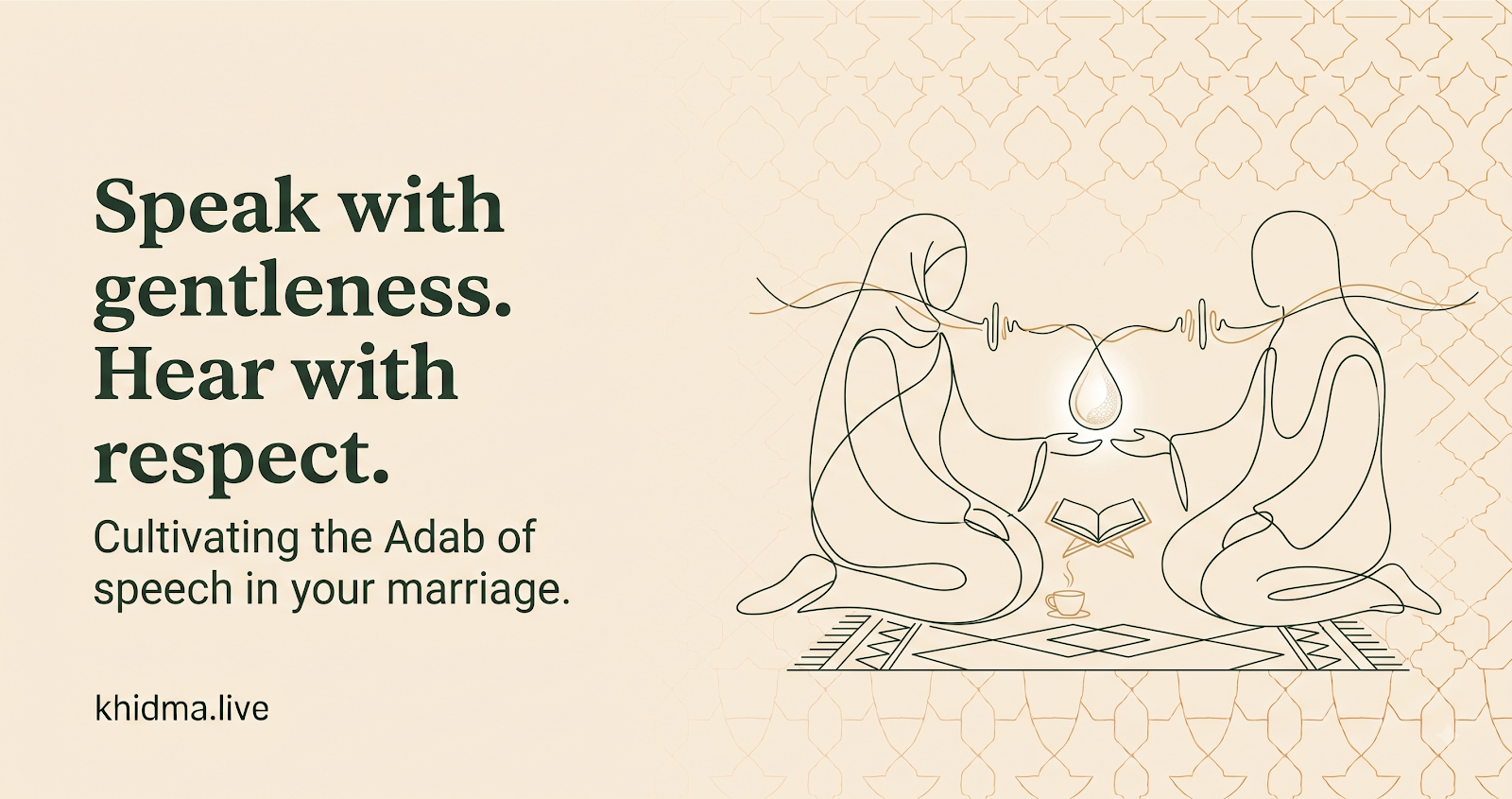
By Team Khidma.live
You have rehearsed it a hundred times. In the car. At the sink. Lying awake at two in the morning with your back to him. You know exactly what you want to say, and you know exactly how it will go: you will say one sentence, he will hear an accusation, and within four minutes you will be arguing about something that happened in 2023.
So you say nothing. Again. And the thing you needed to say goes back into the drawer with all the others.
This is not a failure of courage. Most women who reach out to Khidma.live have already tried — often for years — and have learned that trying makes it worse. What follows is not about being braver. It is about changing the conditions of the conversation so that it has a chance of surviving the first ninety seconds — and about the manner of speech Islam actually asks of both spouses, which is more specific, and kinder to you, than the version most women are handed.
The Short Answer
You cannot control whether he listens. You can control four things: when you raise it, how you open, how much you raise at once, and what you do when it goes badly. Almost every conversation that ends in a fight has failed on at least one of the first three — usually the first.
The single highest-impact change most women can make is this: stop raising it in the moment of hurt. Raise it later, when nothing is happening, from a neutral position, about one thing only.
Why Talking to Your Husband Feels Impossible Right Now
There is usually a specific history behind the silence, and naming it helps.
Every attempt has cost you. If the last four times you raised something ended in a night of shouting or a week of the silent treatment, your nervous system has correctly learned that speaking is expensive. Avoiding it is not weakness. It is a rational response to repeated cost. The problem is that the cost of not speaking accumulates invisibly, and by the time it surfaces it comes out as everything at once.
You raise it at the worst possible moment. Almost universally, the conversation happens when you are already hurt — at the end of a long day, immediately after the incident, or in the middle of an argument about something else. That is precisely when neither of you can hear anything.
The frame gets switched. You raise a need; he hears a verdict on his character. You say "I felt alone this week"; he hears "you are a bad husband." Some men then reach for religious language to close the conversation down — obedience, patience, a good wife wouldn't complain. When that happens, you are no longer having a conversation about your marriage. You are defending yourself in a trial. We look at this more closely in our guide to practical Islamic marriage advice.
You have gone quiet for months and then erupted. This is one of the most common patterns we see. A woman decides to give it time — through Ramadan, through his work stress, through a family visit — saying nothing, absorbing everything. Then one small thing goes wrong and six months of silence arrives in a single evening. He experiences it as an ambush. She experiences it as finally being honest. Both are true, and neither helps.
How to Talk to Your Husband in Islam: The Adab of Speech Between Spouses
Islamic scholarship treats the way spouses speak to each other as a subject in its own right, under husn al-mu'asharah — good companionship. It is not vague advice to be nice. It contains specific, practical instructions, and several of them are precisely the techniques a counsellor would give you.
Speak with the better word
The Qur'an gives believers a general instruction about speech:
"And tell My servants to say that which is best." — Qur'an, al-Isra 17:53
The verse continues by noting that Shaytan sows discord between people — which is to say, the instruction about speech is given precisely because words are where relationships fracture. In a marriage this cuts in a direction most women are not told about: it applies to both spouses. Gentleness is asked of you, and it is asked of him.
Practically, gentle speech is not the same as silent speech. You can say a hard thing softly. What the instruction rules out is the harsh opening, the cold delivery, the sentence designed to wound — not the raising of the matter itself.
Use his name the way the Prophet ﷺ used names
Affectionate address between spouses is a Sunnah, not a sentimentality. The Prophet ﷺ is reported to have shortened 'A'ishah's name to Yā 'Ā'ish when calling her — a small, ordinary, tender thing.
This matters more than it sounds when a marriage has gone cold. In most struggling marriages the first casualty is not conversation but warmth in address: you stop using his name, or his kunya, or whatever you called him in the first year, and start opening sentences with the complaint itself. Restoring the address before you restore the conversation changes what he hears.
Choose the timing, not just the words
Scholars writing on marital conduct make a point that gets missed: many disagreements happen not because a request is unreasonable, but because it was raised at the wrong moment or in a pressing tone. The classical advice is to avoid bringing needs to a husband who is exhausted, hungry, or has just walked through the door, and to ask in a way that leaves him room to answer without feeling cornered.
That is the same instruction a psychologist would give you, arrived at eight centuries earlier. It is also the single change that resolves most avoidable fights.
Say the gratitude out loud
Appreciation spoken aloud — jazākallāhu khayran, bārakallāhu fīk, or simply naming a specific thing he did — is repeatedly emphasised in the scholarly writing on marriage, and it has a practical function beyond reward. A man who has heard something good from you in the last week receives a difficult conversation differently from one who has heard nothing but grievances for a month.
This is not a trade, and it is not a technique for managing him. But if the only time you speak to him about the marriage is to raise a problem, the problem becomes the marriage in his mind.
How to Talk to Your Husband Without It Becoming an Argument
Pick the time deliberately
Not after a fight. Not at eleven at night. Not when either of you is hungry, exhausted, or has just come off the phone with his mother.
The best times are neutral and side-by-side rather than face-to-face: in the car, on a walk, washing up together. Side-by-side lowers the sense of confrontation considerably. Ask first — "Is now a bad time to talk about something?" — and if he says yes, accept it and name a time instead. That one sentence removes the ambush.
One thing. Not the list.
You have a list. Do not bring the list.
Bringing seven grievances guarantees he will pick the weakest one, argue that, and dismiss the rest by association. Choose the one that matters most this month and speak only about that. The others are not abandoned; they are queued.
Open with the effect, not the accusation
The difference is not politeness. It is that one version can be argued with and the other cannot.
- "You never help with anything" — he can produce counter-evidence, and he will.
- "I have been getting home at ten and still cooking, and I am running out of energy" — there is nothing to argue with. It is your experience.
Three openings that tend to survive:
- "I have been carrying something and I don't want it to grow. Can I tell you?"
- "I need to say something and I am not attacking you. I just need you to hear it."
- "Something has been sitting badly with me since [specific event]. Can we talk about it?"
Say what you need at the end, plainly and small: not "be a better husband," but "I need us to eat together three nights a week," or "I need you to tell me when your mother is coming."
Expect the first reaction to be bad — and do not match it
Defensiveness is the normal first response, not the final one. If he raises his voice or turns it back on you, the conversation is not lost yet. It is lost if you escalate with him.
The strongest move here is a pause. Sixty seconds of silence before you respond — genuinely counted — is a technique our counsellors use constantly, because it interrupts the reflex that turns a difficult conversation into a fight. If sixty seconds is not enough, end it cleanly: "I don't want this to become a fight. Can we come back to it tomorrow?" Then actually come back to it tomorrow. Leaving it is how it joins the drawer.
What to Do When Your Husband Refuses to Talk
Some men will not engage at all. He walks out, tells you not to think about it, goes on his phone, or gives you days of silence afterwards. This is a different problem from a conversation going badly, and it needs to be named as such — persistent withdrawal is not a communication style, it is a pattern with real spiritual and psychological weight. We have written about that in depth in When Silence Becomes Toxic.
What still works when direct conversation does not:
Write it. A letter or a long message removes the two things that derail spoken conversations: his immediate defensiveness and your fear of his face. He can read it three times. Many men respond to writing when they cannot respond in the room.
Bring in a third voice. This is the oldest answer in the tradition — the Qur'an directs spouses in conflict towards arbitration from each side (an-Nisa 4:35) rather than leaving them to resolve it alone. In practice, this is also why counselling works when arguing does not: a scholar or counsellor is not his wife, so what they say does not register as criticism from you.
There is a hard truth in this. Many husbands accept from a scholar exactly what they refuse from their wife — the same point, the same words, received completely differently. That is not fair. It is, however, often usable.
Go alone if he will not come. You do not need his agreement to get support. Most sessions at Khidma.live begin with one spouse. Clarity for one person changes what happens between two, and it also tells you something real: whether you are in a marriage that needs better communication, or in a marriage where you are the only one working on it. If you want to understand what the process involves before committing to anything, our guide to Muslim marriage counselling and couples therapy walks through it, and if you are wondering whether it is permissible at all, we have addressed that separately in Is marriage counselling haram in Islam?
Is It Wrong for a Wife to Raise Problems With Her Husband?
Many women hesitate not because they lack words but because they have been told, sometimes by family and sometimes from the minbar, that a wife who raises problems is failing at patience.
Two things are worth separating here.
The first is culture and deen. A great deal of what is presented as Islamic instruction about wifely silence is inherited cultural expectation, and those who teach it as religion are not always distinguishing between the two. Note what the adab above actually asks: gentleness in how you speak, care in when you speak. Not that you don't speak. That distinction matters, and it is the sort of question a qualified scholar should answer for your specific situation rather than an article written for everyone.
The second is what sabr actually asks of you. Sabr is repeatedly described in the tradition as perseverance — holding steady while continuing to act — rather than resignation to a situation you have stopped trying to change. Speaking honestly to your husband about your marriage is not the opposite of patience. In many cases it is what patience looks like when it is doing something.
The Qur'an describes the purpose of marriage in terms of tranquillity, affection and mercy (ar-Rum 30:21). A marriage in which one person cannot speak is not yet at that description. Wanting to move it closer is not a complaint.
When Talking Is Not the Answer
Communication advice has limits, and it is dishonest not to name them.
If your husband responds to being spoken to with intimidation, threats, or physical harm, the problem is not the way you are opening the conversation, and no amount of gentleness in your phrasing will fix it. If that is your situation, please contact your local domestic abuse service or emergency number before anything else — the advice in this article assumes both people are safe, and it does not apply where raising a concern is dangerous.
The same caution applies more quietly elsewhere. If he has agreed to change many times and nothing has followed for years, the issue is not phrasing. And if raising anything triggers days of punishment, the dynamic itself needs addressing before any technique will help.
In those situations the next step is not a better script. It is speaking to someone qualified — a scholar for the rulings side, a Muslim psychologist for the emotional and behavioural side, and often both. You can start by asking a scholar a question for free, or read about how free Islamic counselling works before deciding.
If Nothing Changes
Give it a real window — six to eight weeks of trying the approach above consistently, not one attempt. Then look honestly at what happened. Did he engage even slightly? Did anything shift? Did he agree and then do nothing, again?
You are not obliged to decide anything at that point. But you will know something you did not know before, and that knowledge is worth having whichever direction you eventually take. You were never meant to work this out alone, and you are not required to keep guessing.
Frequently Asked Questions
How do I talk to my husband about our marriage without him getting angry?
Choose a neutral moment rather than the moment of hurt, raise one issue rather than several, and open with how something affected you instead of what he did wrong. Anger is usually a response to feeling accused, so removing the accusation from the opening removes most of the trigger.
What does Islam say about how a wife should speak to her husband?
The scholarly writing on husn al-mu'asharah emphasises gentle speech, affectionate address, choosing the right moment for requests, and expressing gratitude aloud. Note that these concern the manner of speech, not whether a wife may raise a concern at all.
My husband shuts down every time I bring something up. What do I do?
Try writing it instead of saying it — a letter removes his need to defend himself in real time. If shutting down is a consistent pattern rather than an occasional reaction, that is worth addressing directly; our article on the silent treatment covers what persistent withdrawal does to a marriage.
Is it disrespectful in Islam for a wife to raise problems with her husband?
Raising a concern is not disobedience, and much of what is presented as religious instruction on this point is cultural expectation rather than a ruling. For your specific circumstances, ask a qualified scholar rather than relying on general advice.
When is the best time to talk to my husband about a problem?
When neither of you is tired, hungry, or upset, and when nothing has just happened — advice found in the classical writing on marital conduct as well as in modern counselling. Side-by-side settings such as driving or walking tend to work better than sitting across from each other.
What if my husband refuses to go to counselling?
Go alone. Most sessions at Khidma.live begin with one spouse, and there is real value in one person getting clarity even if the other does not participate.
How do I stop every conversation turning into an argument about the past?
Name one issue and hold the boundary. If the past is raised, say you will discuss it another time and return to the single point. Bringing a list of grievances almost guarantees the conversation collapses.
My husband says I should have sabr and stop complaining. Is he right?
Sabr in the tradition is closer to perseverance than to silence. Enduring while continuing to seek a resolution is different from accepting a situation permanently, and the two should not be treated as the same thing.
Should I talk to my husband or to my family first?
Generally your husband first, unless you are unsafe. Involving families early frequently escalates a private difficulty into a two-family conflict that becomes harder to resolve.
Can I speak to a female counsellor about this?
Yes. Khidma.live has certified Muslim women psychologists and counsellors, and you can filter by gender and language when choosing.
Sources
Qur'anic references: al-Isra 17:53; an-Nisa 4:35; ar-Rum 30:21.
The material on husn al-mu'asharah above draws on the following works:
- Nayl al-Amani min Fatawa al-Qadi Muhammad ibn Ismail al-Amrani, vol. 2, p. 76
- Durus lil-Shaykh Muhammad Hassan, vol. 120, p. 4
- Tafsir Ahmad Hutaiba, vol. 207, p. 5
- La Tahzan, vol. 1, p. 437
- Silsilat Imaniyat, vol. 4, p. 3; vol. 5, p. 3
- Mawqi al-Islam Su'al wa Jawab, vol. 7, p. 971
- Durus lil-Shaykh Abi Ishaq al-Huwayni, vol. 28, p. 5
- Durus al-Shaykh Abd al-Hayy Yusuf, vol. 48, p. 5
- Durus li al-Shaykh Saeed bin Musfir, vol. 65, p. 18
- Awdat al-Hijab, vol. 2, p. 418
- Durus li al-Shaykh Muhammad al-Mukhtar al-Shinqiti, vol. 28, p. 18
Ask a scholar your question — free → A named, verified scholar records a private 3–5 minute audio answer for your specific situation.
Read: When Silence Becomes Toxic → What persistent withdrawal does to a marriage, spiritually and psychologically.
Take the free Nafs Assessment → A private few minutes to understand what you are carrying, and who is right to speak to.