*By Team Khidma
It was written into the nikahnama. Everybody in the room heard the figure. And then the wedding ended and nobody mentioned it again.
Years later you find yourself wondering whether you were ever actually given it — and whether it would be shameful to ask. Perhaps someone has already told you that asking would be greedy, that a good wife doesn't chase money, that it was only a formality anyway.
It was not a formality. It was a debt, and in most cases it still is.
The Short Answer
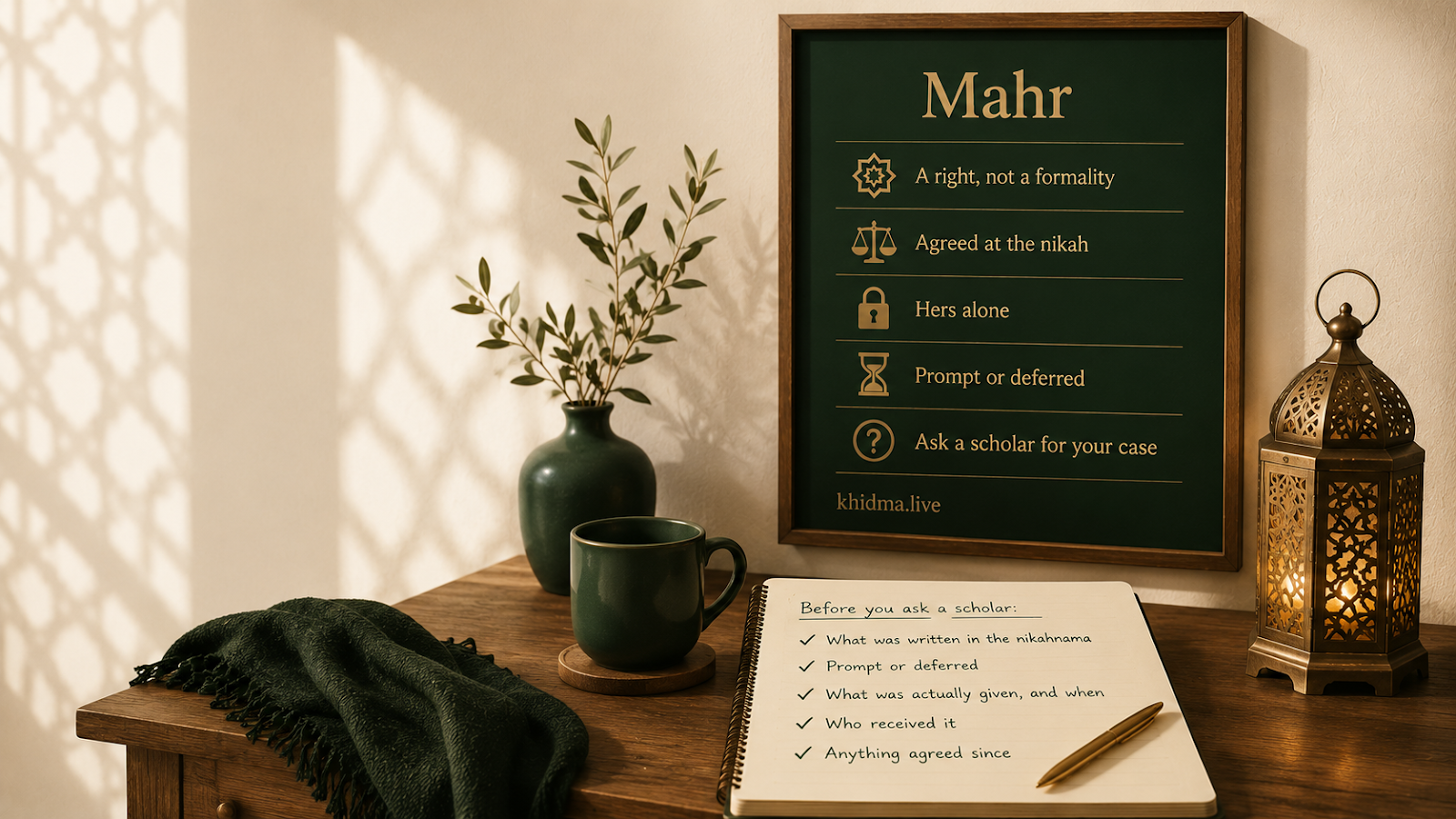
Mahr is an obligatory payment from the husband to the wife, arising from the marriage itself. It belongs to her alone — not to her father, not to her guardian, not to the household. It is not a purchase price, and it is not something her family provides.
If it was agreed and never handed over, it remains a debt. Time passing does not cancel it. If the husband dies, it is paid from his estate before any inheritance is distributed.
What is mahr?
Mahr — also called sadaq, and in South Asia haq mehr — is a mandatory right granted directly to the woman upon marriage. It is not optional, and it is not conditional on anything she does afterwards.
"And give the women their bridal gifts graciously. But if they give up willingly to you anything of it, then take it in satisfaction and ease." — an-Nisa 4:4
Scholars explain that the word nihlah signifies an unconditional, obligatory gift prescribed by Allah. The verse also settles a second question before it is asked: if she may willingly give some of it back, then it was unambiguously hers to begin with.
"So for whatever you enjoy of marriage from them, give them their due compensation as an obligation." — an-Nisa 4:24
And the marriage contract itself is singled out among all contracts:
"The most rightful condition you are duty-bound to fulfil is that by which you made marital relations lawful." — Sahih al-Bukhari and Sahih Muslim
Who does the mahr belong to?
Her. Only her.
Neither her father, her guardian, nor her husband has any claim on it unless she gives part of it away out of genuine free will and full consent.
This is the point most often lost in practice. In many families the mahr is negotiated between two sets of parents, quoted as a figure at the nikah, and then either absorbed into wedding costs or never transferred at all. Sometimes it goes to her father. Sometimes it is spent on the function.
None of that is the mahr being paid. It is paid when it reaches the wife and she has control of it. She may then choose to give it away, spend it on the household, or hand it to her parents — but that choice must be hers, made after receiving it.
The Qur'an is unusually direct about a husband reclaiming it:
"...and you have given one of them a great amount, do not take back from it anything. Would you take it in injustice and manifest sin?" — an-Nisa 4:20
How much should mahr be? Is there a minimum or maximum?
Islamic law does not impose a rigid minimum or maximum. Any lawful property, money, or valuable non-material service accepted by the bride is valid.
What the Sunnah does emphasise, repeatedly, is ease.
"The best bridal gift is the easiest." — Recorded by Abu Dawud and al-Hakim; graded sahih
"Among the signs of a woman's blessing are the ease of her proposal and the ease of her bridal gift." — Recorded by Ahmad and Ibn Hibban; graded hasan
Sahl ibn Sa'd narrated that a man came wanting to marry but had nothing. The Prophet ﷺ told him to look for something, even an iron ring. He returned with nothing at all. The Prophet ﷺ then asked what he knew of the Qur'an, and married him to her on the basis of what he had memorised. — Sahih al-Bukhari and Sahih Muslim
Aisha (may Allah be pleased with her) reported that the Prophet's own mahr to his wives was twelve uqiyyahs and a nash — five hundred silver dirhams. — Sahih Muslim
And Umar ibn al-Khattab addressed the practice of inflation directly:
"Do not be excessive in the bridal gifts of women. Had it been an honour in this world or piety before Allah, the Prophet ﷺ would have been the foremost among you in it." — Recorded by Abu Dawud, al-Tirmidhi and al-Nasa'i; graded sahih
What follows practically: a modest mahr is not a religious failing, and an enormous one is not a religious achievement. A figure quoted for prestige that nobody intends to pay is worse than a small figure handed over on the day.
What if no mahr was mentioned in the nikah?
The marriage remains valid. This is known as nikah al-tafwid.
The wife is still entitled — to mahr al-mithl, the customary mahr of women of comparable standing, payable on consummation or on his death.
"There is no blame upon you if you divorce women you have not touched, nor specified for them an obligation." — al-Baqarah 2:236
Abdullah ibn Mas'ud was asked about a woman whose husband died before any mahr was fixed and before consummation. He ruled that she receives the full mahr of women of her standing, without deficit or excess, that she observes the iddah, and that she inherits. Ma'qil ibn Sinan al-Ashja'i then stood and said the Messenger of Allah ﷺ had given exactly that judgement regarding Birwa' bint Washiq. — Recorded by Abu Dawud, al-Tirmidhi and al-Nasa'i; graded sahih
So "nothing was written down" does not mean nothing is owed.
Prompt and deferred mahr
Mahr is usually structured one of two ways, and knowing which yours was matters.
Prompt (mu'ajjal) — due immediately, at or around the nikah.
Deferred (mu'akhkhar) — due later, most commonly on divorce or on the husband's death, whichever comes first.
Many nikahnamas split the amount between the two. Many families in practice treat the whole thing as deferred without ever saying so, which is how a mahr quietly becomes something nobody expects to be paid.
Deferred does not mean forgiven. It means scheduled.
What if we divorce before the marriage is consummated?
If a mahr was specified, she receives half of it.
"And if you divorce them before you have touched them and you have already specified for them an obligation, then give half of what you specified..." — al-Baqarah 2:237
The verse continues that either party may forgo their portion, and that to forgo is nearer to righteousness.
If no mahr was specified, she receives mut'ah — a consolatory provision scaled to the husband's means (al-Baqarah 2:236).
What if my husband never paid my mahr?
It stands as a personal debt (dayn) upon him.
- It does not expire with time. Not after five years, not after twenty.
- If he dies, it is paid from his estate before any inheritance is distributed to heirs. Ahead of the children, ahead of the parents.
- Marrying with the intention of never paying is gravely warned against.
"Any man who marries a woman for a bridal gift, small or large, having no intention in his heart to fulfil her right — having deceived her — and dies without paying it, will meet Allah on the Day of Resurrection..." — Recorded by al-Tabarani in al-Awsat and al-Saghir
That is among the strongest warnings in this area, and it is worth knowing it exists, whatever the state of your marriage.
On waiving it. A wife may forgive part or all of her mahr, and the Qur'an explicitly permits it. But the verse describes a woman giving it up willingly. A waiver given under pressure, to end an argument, or because she was told a good wife would not ask, is a different thing.
This also matters after his death, and it is frequently missed. Unpaid mahr is a debt owed to you, and debts are settled from a man's estate before any inheritance is distributed to his heirs — before his children, before his parents, before anyone. A widow who is told there is nothing left for her, or who is handed a share as though it were the whole of what she is owed, may be owed the mahr as well as her portion.
The two are separate. Our guide to Islamic inheritance and wills sets out the order an estate must be settled in.
Do I have to return the mahr in khula?
Khula is the route by which a wife initiates the end of the marriage, and it generally involves returning the mahr or agreeing some form of compensation in exchange for release. Beyond that, the specifics vary — whether the whole amount is returned or a portion, whether the figure is negotiable between the couple, and what happens where the mahr was never actually handed over in the first place. These are not questions with one answer that fits every marriage; they turn on what was agreed, what was paid, what has passed between you since, and which position your circumstances fall under. Speak to a scholar who can hear the details before you agree to return anything, and certainly before you sign anything. Two practical notes while you prepare that conversation: if the mahr was never paid to you, ask explicitly what is being returned rather than assuming, and be clear that what is under discussion is the mahr — your own earnings, your own possessions and gifts made to you are a separate matter. If you are weighing this route, our guide to khula in Islam covers the grounds and the process, and if the marriage may already have ended without your knowing, is my nikah still valid deals with talaq..
What if I already said I'd waive my mahr?
A wife may forgive part or all of her mahr — the Qur'an says so plainly, and describes her giving it up willingly, of her own accord. What is much less clear is what happens when the willingness was not really there: when the waiver was given to end an argument, or under pressure from family, or because she was told repeatedly that a good wife would not ask, or at a moment when she felt she had no other way to keep the peace. Whether a waiver given in circumstances like those holds is a genuine question, and it depends on the degree of pressure, what was said, and the position followed. If you agreed to drop your mahr and you are not sure the agreement was freely made, do not assume the matter is closed. Ask a scholar what your specific situation means — it costs nothing to find out, and it is not a question you should be answering on your own.
If you are weighing this route, our guide to khula in Islam covers the grounds and the process. If the marriage may already have ended without your knowing, is my nikah still valid deals with talaq.
Mahr and dowry are not the same thing
This confusion causes real harm, so it is worth stating plainly.
Mahr flows from husband to wife. It is obligatory in Islam.
Dowry — jahez, dahej flows from the bride's family to the groom's. It is a cultural practice, not an Islamic obligation, and where it involves demands made on a bride's family it runs directly against the direction the Qur'an sets.
Many families do both. Many do only the second. A woman whose parents spent their savings furnishing her husband's house, and who never received a rupee of the mahr written in her own nikahnama, has had the arrangement exactly inverted.
Distinguishing culture from deen is one of the things a scholar is for — and one of the harder conversations to have inside a family, which is why hearing it from someone outside it often changes what becomes possible.
Is my gold and jewellery part of my mahr?
Only if it was designated as the mahr.
Jewellery given at a wedding falls into different categories depending on who gave it, when, and on what terms — mahr, a gift to her, a loan of family jewellery, or the in-laws' property that she was expected to wear. These carry different rulings, and families frequently disagree about which applies years later, usually at the worst possible moment.
If your marriage is under strain and jewellery is involved, write down now what you were given, by whom, and what was said at the time. These details fade fast and are almost always contested later.
Asking for what you are owed is not greed
Most women who never raise the mahr know perfectly well that it is theirs. What stops them is that raising it feels like an accusation — as though asking implies the marriage is failing, or that she is calculating rather than trusting.
The Qur'an calls it a right and instructs that it be given graciously. A right you are afraid to mention is not functioning as a right.
That does not make the conversation easy, and it is often not really about money at all — it is about what it means to ask your husband for something he has quietly decided not to give. If that is the harder half of your situation, how to talk to your husband may be more use than any fiqh answer.
And if you need to know where you actually stand — what was owed, whether it still is, and what applies in your circumstances — that is a question for a scholar who can hear the specifics.
Frequently Asked Questions
What is mahr in Islam? An obligatory payment from husband to wife arising from the marriage contract, described in the Qur'an as nihlah — an unconditional obligatory gift. It belongs to her alone.
Is mahr compulsory? Yes. It is a divine right of the wife, not an optional gift, and the marriage contract is singled out in the Sunnah as the condition most deserving to be fulfilled.
Who keeps the mahr — the wife or her family? The wife. No father, guardian or husband has a claim on it unless she gives part of it away of her own free will after receiving it.
Is there a minimum or maximum mahr? Islamic law sets no rigid minimum or maximum. Any lawful property, money or valuable service accepted by the bride is valid, and the Sunnah strongly encourages ease.
What if no mahr was mentioned at the nikah? The marriage is valid, and the wife is entitled to mahr al-mithl — the customary mahr of women of comparable standing.
What is the difference between prompt and deferred mahr? Prompt (mu'ajjal) is due at the nikah. Deferred (mu'akhkhar) is due later, usually on divorce or death. Deferred does not mean forgiven.
My husband never paid my mahr. Is it still owed? Yes. It stands as a personal debt that does not expire with time, and if he dies it is paid from his estate before any inheritance is distributed.
What happens to the mahr if we divorce before consummation? If an amount was specified, she receives half. If none was specified, she receives mut'ah — a provision scaled to his means.
Is dowry the same as mahr? No. Mahr goes from husband to wife and is obligatory. Dowry or jahez goes from the bride's family to the groom's and is cultural, not an Islamic requirement.
Is my gold and jewellery part of my mahr?
Jewellery given around a wedding is one of the most commonly disputed things in a marriage, and it is disputed precisely because the same gold can fall into several completely different categories. It may have been designated as the mahr itself. It may have been a gift to you, which is yours outright. It may be family jewellery lent to you to wear. It may belong to your in-laws and have been given to you only for the occasion. Each of these carries a different ruling, and families routinely disagree about which applied — usually years later, at the worst possible moment, when nobody can agree what was said at the time. Whether your gold counts as mahr depends on what was actually stated and understood when it was given, which means it is a question for a scholar who can hear your specific circumstances rather than one an article can answer for everyone. What you can do today, regardless: write down what you were given, by whom, on what occasion, and what was said about it. Memory of these details fades within a couple of years, and the wording is often the entire dispute.
Ask a scholar your question — free → Tell a named, verified scholar what was agreed and what was paid. You'll receive a private audio answer for your situation — no payment, no obligation.
Read: Khula in Islam → The route a wife can initiate, and what it involves.
Take the free Nafs Assessment → A private few minutes to understand what you are carrying, and who is right to speak to.