By Team Khidma · Reviewed by Zulekha Shakoor Rajani
When someone types "Islamic counselling near me" into Google, they are usually asking three things at once.
Is there anyone qualified around here? Is there anyone who will understand my faith without me having to explain it? And — often unspoken — is there anyone I can see without my community finding out?
The first two are hard to satisfy locally in most cities. The third is often impossible.
This article covers what actually exists near you, what to look for in a Muslim counsellor, and why for a great many Muslims the honest answer is that "near me" turns out to be the wrong filter entirely.
Why Finding Islamic Counselling Locally Is So Difficult
The shortage is not imagined. There are structural reasons behind it.
The specialism barely exists as a profession. A counsellor who is both clinically qualified and trained to work within an Islamic framework is a narrow overlap of two fields. In most cities there are a handful at most, and in many there are none at all.
Where they exist, they cluster. Practitioners concentrate in cities with large Muslim populations — London, Birmingham, Dearborn, Toronto, Dubai. Outside those, provision thins out fast. A Muslim family in a smaller town may have no faith-competent option within an hour's drive.
Local often means known. This is the part search results never account for. In a community where everyone attends the same mosque, the qualified Muslim counsellor down the road may know your husband, your father-in-law, or your children's teacher. Proximity, which normally makes a service easier to use, becomes the exact reason it cannot be used.
And a counsellor is not a scholar. Many people searching for Islamic counselling actually need a ruling — on their nikah, on their rights, on whether something is permissible. That is a scholar's expertise, not a therapist's, and confusing the two wastes months.
What Actually Exists Near You
Worth checking before assuming nothing is available.
Your local mosque. Most imams will make time to speak with you, and it costs nothing. The limits are real, though: most imams have no counselling training, access can be difficult for women, and the confidentiality question above applies with full force.
Muslim charities and community organisations. In the UK, US and elsewhere, several run counselling services or helplines, often free or subsidised. These are staffed by trained people and genuinely worth pursuing. Waiting lists tend to be long and coverage is patchy by region.
Therapist directories. Most national directories let you filter by religion or specialism. You will find Muslim practitioners this way, though "Muslim" on a profile tells you the practitioner's background, not whether they work within an Islamic framework. Those are different things, and the distinction matters.
Domestic abuse services. If there is violence, threat, or coercive control in your situation, specialist support is free and confidential in most countries, including several Muslim-specific services. If that describes your situation, please treat it as more urgent than anything else in this article.
What to Look For — Locally or Online
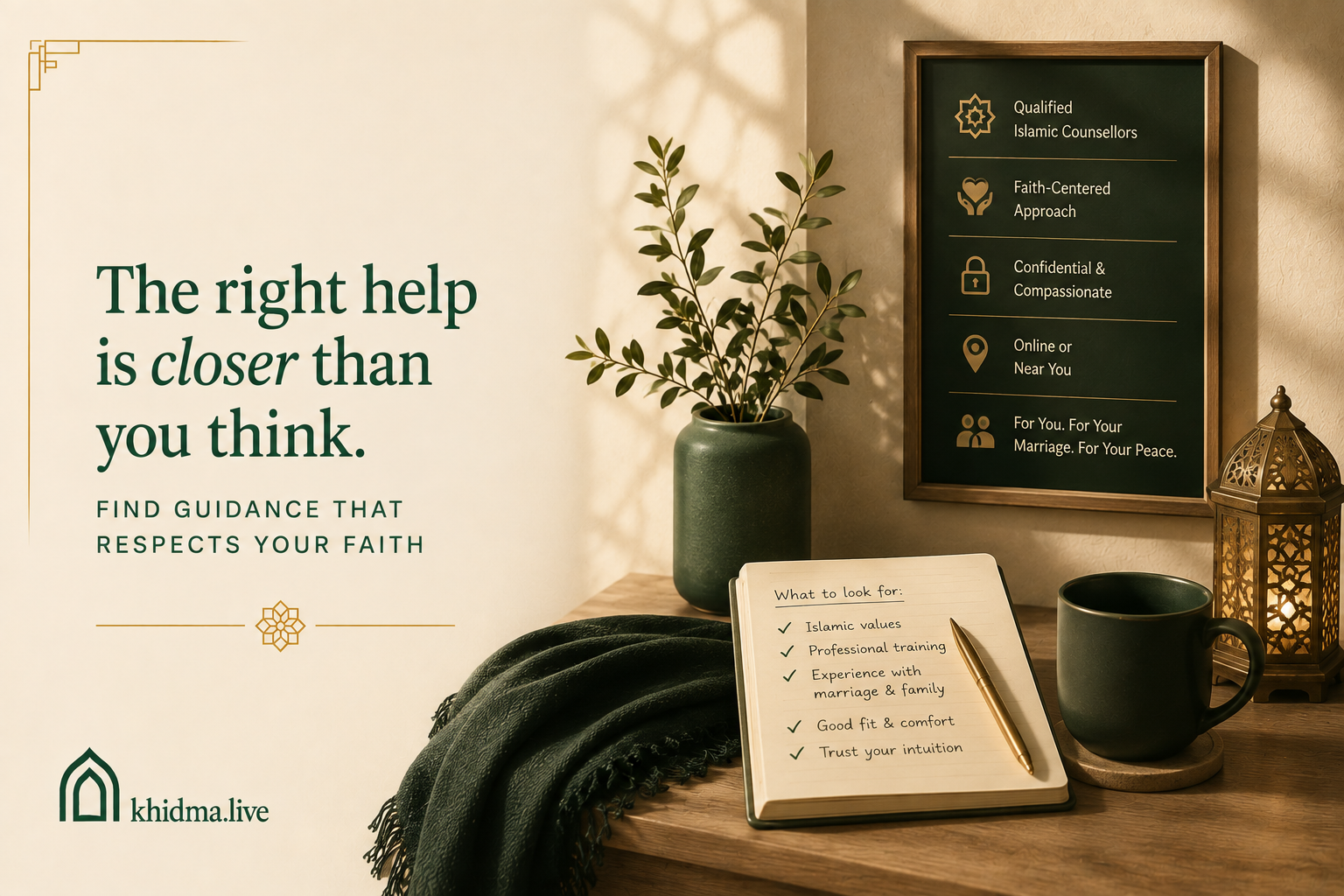
Whichever route you take, the same four things determine whether the help is any good.
Verifiable credentials. For a counsellor, a recognised clinical qualification and professional registration. For a scholar, a named institution you can actually check. A biography that says "studied under various scholars" without naming any is not a credential, and religious guidance from unverifiable sources is precisely the problem most people are trying to escape.
Genuine Islamic literacy, not just Muslim identity. A Muslim therapist trained purely in secular frameworks may still treat your faith as a coping mechanism to work past rather than a foundation to build on. Ask directly how they integrate Islamic principles into their practice. The answer will tell you a great deal.
The right discipline for your actual problem. If the question is whether a talaq was valid, you need a scholar. If the problem is a pattern of withdrawal, betrayal trauma, or anxiety, you need a psychologist. Many situations need both — and that combination is genuinely rare in a single local practice.
Real confidentiality. Not a policy on a website. Ask concretely: who else knows you attended, what is recorded, and how long it is kept.
Why "Near Me" Is Usually the Wrong Filter
Here is the uncomfortable part, and it's worth saying plainly.
For most Muslims, restricting the search to what is geographically close does not improve the help available. It shrinks the pool from "every qualified practitioner in the world who speaks your language" to "whoever happens to work within twenty miles" — and then adds the risk that they know someone you know.
Consider what location genuinely buys you in counselling. Sitting in the same room. That is real, and for some people it matters a great deal.
Now consider what it costs. A far smaller choice of practitioners. Little chance of finding both a scholar and a psychologist who work together. Travel and childcare. A waiting room in your own neighbourhood. And, for many women, the constant possibility of being seen.
Online guidance inverts that trade. You get access to genuinely qualified people regardless of where you live, you can be matched to the specific expertise your situation needs, and nobody in your community ever knows.
For Muslims in smaller towns, in Western cities without established Muslim mental health provision, or in tightly-knit communities where privacy is the whole point — online is frequently not the compromise. It is the better option.
How This Works on Khidma.live
Khidma.live connects Muslims with verified Islamic scholars — graduates of Masjid al-Haram in Makkah and Madinah University — and certified Muslim psychologists with faith-integrated clinical training.
Sessions are audio-only. No video, no waiting room, nothing that could be seen on a shared screen at home. There is no local branch to walk into and no one to run into afterwards.
If you are not sure which you need, the Nafs Assessment is free — it asks what you are carrying in your own words and matches you to the right practitioner with the reason for the match.
And you can ask a scholar a question for free before booking anything, which for many people is a more useful first step than a full session.
Available across the United Kingdom, United Arab Emirates, United States, and beyond.
Frequently Asked Questions
1. How do I find Islamic counselling near me?
Start with your local mosque, Muslim charities or community organisations in your area, and national therapist directories filtered by faith. Provision is limited outside cities with large Muslim populations, so online options are worth considering alongside local ones.
2. Is there such a thing as a Muslim therapist near me?
Possibly, though qualified Muslim therapists with genuine Islamic training are concentrated in a small number of cities. Directories will show Muslim practitioners, but a Muslim background does not automatically mean they work within an Islamic framework — worth asking directly.
3. What is the difference between an Islamic counsellor and an Islamic scholar?
A scholar has formal training in Islamic sciences and can address questions of ruling, rights and obligations. A counsellor or psychologist has clinical training and addresses emotional and behavioural patterns. Many situations need both, which is rarely available from a single local practice.
4. Can I get Islamic counselling online instead of locally?
Yes, and for many Muslims it works better. Online access removes the geographic limit on who you can work with, allows matching to specific expertise, and provides privacy that local services often cannot.
5. Is online Islamic counselling as effective as in person?
For most concerns, research on remote therapy shows outcomes comparable to in-person work. What matters far more is the practitioner's qualification and their fit with your situation — both of which are usually better online, simply because the pool is larger.
6. How do I know if an Islamic counsellor is qualified?
Look for a recognised clinical qualification and professional registration for counsellors, and a named, checkable institution for scholars. Ask how they integrate Islamic principles in practice. Vague credentials are a reason to keep looking.
7. Can I speak to a Muslim counsellor without my family knowing?
Yes. Online sessions leave no local trace — no waiting room, no appointment near home, no one to see you arrive. On Khidma.live sessions are audio-only and private.
8. Is there free Islamic counselling near me?
Some mosques and Muslim charities offer free support, though waiting lists are common. Public health services provide free therapy in some countries, usually without Islamic literacy. What free Islamic support actually offers covers the realistic options in more detail.
9. What if there are no Muslim counsellors in my city at all?
This is common outside major cities. Online guidance removes the constraint entirely — you can work with qualified scholars and Muslim psychologists regardless of where you live.
10. Should I see a scholar or a psychologist first?
If your immediate question is about a ruling or your Islamic rights, start with a scholar. If the difficulty is emotional or behavioural, start with a psychologist. If you are unsure, the free Nafs Assessment is designed to help you decide.
The Right Help Matters More Than the Nearest Help
If there is a qualified, faith-competent counsellor near you whom you can see without concern — use them. Proximity is genuinely valuable when everything else lines up.
For most Muslims, it doesn't. The nearest option is rarely the most qualified, seldom offers both Islamic and psychological support, and often carries the exact privacy risk that made you search quietly in the first place.
The better question is not who is closest. It is who is actually qualified to help with this — and can do it without anyone knowing you asked.
Khidma.live connects Muslims with verified Islamic scholars trained at Masjid al-Haram and Madinah University and certified Muslim psychologists — privately and confidentially, wherever you are.
Ask your first question — free →